Guardian -- One of the world's leading climate scientists warns today that the EU and its international partners must urgently rethink targets for cutting carbon dioxide in the atmosphere because of fears they have grossly underestimated the scale of the problem.
In a startling reappraisal of the threat, James Hansen, head of the Nasa Goddard Institute for Space Studies in New York, calls for a sharp reduction in C02 limits.
Hansen says the EU target of 550 parts per million of C02 - the most stringent in the world - should be slashed to 350ppm. He argues the cut is needed if "humanity wishes to preserve a planet similar to that on which civilisation developed". A final version of the paper Hansen co-authored with eight other climate scientists, is posted today on the Archive website. Instead of using theoretical models to estimate the sensitivity of the climate, his team turned to evidence from the Earth's history, which they say gives a much more accurate picture.
The team studied core samples taken from the bottom of the ocean, which allow C02 levels to be tracked millions of years ago. They show that when the world began to glaciate at the start of the Ice age about 35m years ago, the concentration of CO2 in the atmosphere stood at about 450ppm.
"If you leave us at 450ppm for long enough it will probably melt all the ice - that's a sea rise of 75 metres. What we have found is that the target we have all been aiming for is a disaster - a guaranteed disaster," Hansen told the Guardian.
At levels as high as 550ppm, the world would warm by 6C, the paper finds. Previous estimates had suggested warming would be just 3C at that point.
Hansen has long been a prominent figure in climate change science. He was one of the first to bring the crisis to the world's attention in testimony to Congress in the 1980s.
But his relationship with the Bush administration has been frosty. In 2005 he accused the White House and Nasa of trying to censor him. He has steadily revised his analysis of the scale of the global warming and was himself one of the architects of a 450ppm target. But he told the Guardian: "I realise that was too high."
The fundamental reason for his reassessment was what he calls "slow feedback" mechanisms which are only now becoming fully understood. They amplify the rise in temperature caused by increasing the concentration of greenhouse gases. Ice and snow reflect sunlight but when they melt, they leave exposed ground which absorbs more heat.
As ice sheets recede, the warming effect is compounded. Satellite technology available over the past three years has shown that the ice sheets are melting much faster than expected, with Greenland and west Antarctica both losing mass.
Hansen said that he now regards as "implausible" the view of many climate scientists that the shrinking of the ice sheets would take thousands of years. "If we follow business as usual I can't see how west Antarctica could survive a century. We are talking about a sea-level rise of at least a couple of metres this century."
The revised target is likely to prompt criticism that he is setting the bar unrealistically high. With the US administration still acting as a drag on international efforts, climate campaigners are struggling even to get a 450ppm target to stick.
Hansen said his findings were not a recipe for despair. The good news, he said, is that reserves of fossil fuels have been exaggerated, so an alternative source of energy will have to be rapidly put in place in any case. Other measure could include a moratorium on coal power stations which would bring the C02 levels to below 400ppm.
Hansen's revised position will pile yet further pressure on Britain over plans to build a new generation of coal power stations. Last year he wrote to Gordon Brown urging him to block the first such power station; the Royal Society has made similar suggestions to the government.
Monday, April 07, 2008


Sunday, April 06, 2008
UK Biofuel Needs 'Threaten Delta'
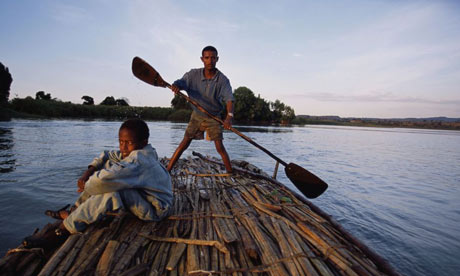
A papyrus reed raft on Lake Tana, source of the Blue Nile and home to many bird species. Photograph: Michael S.Lewis/Corbis
The Guardian -- The lush, muddy wetlands of the Tana river delta, teeming with birds and home to hippos and crocodiles, lions and elephants, are more than 4,000 miles from Britain. But this patchwork of savannah and mangrove swamp on the east coast of Africa is the latest victim of the British thirst for biofuels.
To meet the worldwide demand and the regulation that, from next week, petrol and diesel sold in Britain must be mixed with bioethanol or biodiesel as part of a drive to cut the carbon dioxide emissions from fossil fuels, the Mumias Sugar Company in Kenya is planning to plant 20,000 hectares of the Tana delta to grow sugar cane for biofuels and food. The £165m project, including an ethanol refinery and food-processing plant, promises to create thousands of jobs in an area dominated by traditional cattle herding, small-scale rice and subsistence farming.
But environmental campaigners claim that the scheme would destroy the wetlands - home to 345 species of birds, including the threatened Basra reed warbler, the Tana river cisticola, and 22 species of waterbirds such as slender-billed gulls and Caspian terns, which are so numerous there they are considered 'internationally important' to the global populations. Globally the boom in this and other projects is causing growing concern about environmental damage and the part played by biofuels in pushing up food prices.
The UN Secretary-General, Ban Ki-moon, has called for a comprehensive review of the policy on biofuels as the crisis in world food prices threatens to trigger global instability. Last week former Labour Environment Minister Elliot Morley called for the government to delay the new biofuel requirement until 'comprehensive certification and assessment schemes are put in place', echoing criticism by the Environment Department's chief scientific adviser, Professor Robert Watson. The chairman of the UN's Intergovernmental Panel on Climate Change, Dr Rajendra Pachauri, has also spoken out against the risk of biofuels, especially of growing corn for ethanol in the US.
In the Tana delta, the two main worries are that monoculture planting would replace a large area of rich and diverse habitat, including unusual but unprotected Borassus palm savannah, and that irrigation for the new plants would use up to one third of the available water, claims the Royal Society for the Protection of Birds, which has taken the unusual step of protesting directly to the Kenyan government. Local campaigners say that Kenya's National Environment Management Authority is expected to approve the scheme. Mumias is also only one of a handful of schemes proposed in the delta, including commercial rice-growing and cattle breeding.
If approved, large areas would become 'ecological deserts', destroying wintering grounds for birds and the bugs they feed on, and dams would divert water essential to wildlife and cattle herders during the dry season, warned Paul Matiku, executive director of campaign group Nature Kenya. Matiku is also worried about water diversion causing soil erosion, pollution harming fish stocks and damage to the nascent tourism industry. 'This development would be a national disaster, wreaking havoc with the area's ecosystem and spelling the end for wildlife across much of the delta.' The plans submitted by Mumias suggest about half the crop could be used for food and half for biofuel, primarily to sell in Kenya. But high prices for biofuels overseas could force Mumias to sell to European and US buyers, said Paul Buckley, of the RSPB.
British consumers should be protected by 200 pages of regulations governing the sustainability of biofuels; however, critics claim that indirectly British demand will suck in supplies from other markets, which would then be forced to turn to new suppliers like Mumias. Farmers are also clearing new land for displaced food crops.
British regulations also rely, for the first two years at least, on embarrassing retailers by forcing them to publish details of where they buy their biofuel, but there is no punishment for buying from sources that cause damage to habitats, soil or water.
'It would appear to be the biofuel rage which has convinced them they can make an economic go of this,' said Buckley.
However, the Renewable Energy Association said that not all biofuels were equally harmful. Those planted on land cleared of 'carbon sinks' such as forests were 'clearly bad', and some biofuels, like US ethanol from corn, had little, if any, carbon savings, said Paul Thompson, the association's biofuel analyst. But biofuel made from wheat, and local projects, such as British Sugar's scheme to make bioethanol from sugar beet in Norfolk, were beneficial, he said. Supporters were also excited about the prospect of future biofuels from waste and algae.
Strict rules about which biofuels were considered 'sustainable' should also ensure that companies like BP and Shell bought only from reputable sources, said Thompson.
The Department for Transport said: 'Biofuels have the potential to help reduce the impact of transport on the environment, but we have always been clear about the need to ensure that they are sustainable ... In addition, we recently announced a study into the wider impacts of biofuel.'
'This development would be a national disaster, wreaking havoc with the area's ecosystem and spelling the end for wildlife across much of the delta.'
Subscribe to:
Posts (Atom)