Africa News -- Ethiopian environmentalist Tewolde Berhan Gebre Egziabher, Monday called on farmers worldwide to emulate forest dwellers and manage agricultural ecosystems organically.
Cautioning that farming communities faced the risk of disappearance leaving deserts behind if they increased their reliance on industrially manufactured chemical fertilizers, he said that resorting to chemicals provided a short-term solution to degraded soils.
Tewolde, Director of Ethiopia's environment protection agency and a laureate of The Right Livelihood Award, spoke at the opening of a three-day International Conference on Participatory Forest Management, Biodiversity Conservation and Livelihoods in Africa.
"Forest dwellers have lived for over 100,000 years interacting with forest ecosystem without needing to resort to industrially produced chemicals to maintain soil fertility in their ecosystems.
"Farmers that manage both farms and forests have managed to live on their farms for thousands of years. But those who could not do it have disappeared with their abused farms," he noted.
The conference, organised by Ethiopia's Agriculture and Rural Development Ministry in collaboration with some NGOs, has brought together experts and practitioners to discuss recent findings on a range of issues associated with the establishment of "participatory forest management (PFM)" as a forest management system by local communities in Africa.
Experts agree that PFM plays a significant role towards the realisation of the Convention on Biodiversity, but the conference organisers said the link between PFM and biodiversity conservation in Africa had not been fully explored.
There is also an emerging issue that the costs of biodiversity conservation could be shared between community groups and wider stakeholders at local, national and international levels.
According to Tewolde, the process of continuing to exhaust the deteriorating ecosystem by resorting to the use of chemicals exacerbated the process of desertification.
"Agriculture is becoming increasingly less organic. Farmers are resorting to chemicals to enable the degrading soil to produce crops, until it totally fails to produce crops," he said, noting: "Forests are also shrinking because of climate change. But the present day climate change is human induced."
"Agriculture, even when organic, changes climate if it devastates forests and thus change the dynamics and humidity of the atmosphere," added Tewolde, a renowned biodiversity and bio-safety negotiator and recipient of several international awards.
Ethiopian President Girma Wolde-Giorgis told the meeting that unless serious actions were taken to stop environmental degradation the world might be unable to support the population.
"International collective action is needed not only at rural community level but at the international community level to ensure sustainable use of natural resources and protection of the environment. "There will not be sustainable development without sustainable management of the natural resources," he said.
Girma advocated sound management and use of natural resources to meet the needs of the current generation without compromising the ability of the future generations to meet their own needs.
He also emphasized community involvement in the management of natural resources noting that rural communities in Africa were intrinsically based on natural resources.
Related Posts:
Ethiopian 'Green Chemical' Plant Could Weed Out Polluting Glue
Potent Plant Example of Why Free Science Access Will Aid African Researchers
Tuesday, March 20, 2007


Where the Dinner Table Is an Altar of Thanks
New York Times -- ETHIOPIA is not a country people go to for food. But despite its lack of culinary fanfare, Addis Ababa, the capital city, has a rich and unexpected food culture. And more than just great meals, this is food that comes with a story.
This is a country that serves up grass-fed beef and organic vegetables by default. There are no trendy macro-organic-vegan movements; rather, the livestock graze in open fields because there are no factory farms, and vegetables are rarely treated with pesticides because farmers can’t afford the chemicals. Going there is a step back in time, literally — Ethiopians follow a version of the Julian calendar, so the year is 1999, and Ethiopia will have its millennium celebration on Sept. 12.
On a trip to Addis Ababa last year, I became increasingly intrigued with the cuisine. Everywhere — from dingy streets to polished hotels — I saw people of every age, class and occupation eating the same food and embracing the same traditions. The food is a source of national pride, and a daily reminder of this country’s history.
There are no appetizers or desserts in Ethiopia. Chefs do not craft menus to whet the appetite with an amuse bouche. Food has a primal role: to be filling, nutritious and packed with as much flavor as possible, whether it’s spicy chickpea hummus with caramelized onions, or grilled chicken dripping with a sweet yogurt sauce.
Even at the city’s handful of high-end restaurants (the ones with table service and uniformed servers), there is an unspoken obligation to provide true sustenance. This is a country, after all, that suffered some of the worst famines of recent decades.
And at the heart of every Ethiopian meal is injera. Basically a pancake — or more accurately, a really, really big pancake — injera is made from tef, a sour-wheat-like grain that is mixed with cool water and a pinch of yeast. But unlike a pancake, it isn’t flipped over, so the topside remains spongy, the better to sop up the vegetables and meat in the saucelike wat (sometimes spelled wot or wett) that is ladled on top. In a country where utensils are scarce, injera is not only your dinner plate, it’s also your knife, fork, spoon and sometimes napkin.
When a platter of injera arrives at the table, covered in dips of fresh, locally grown vegetables and farm-raised meats, it is immediately torn apart by everyone within arm’s reach. The ritual is as much about silent gratitude for what the land has offered, as it is about digging into a great meal.
Habesha
The first place I tried injera was at this candlelit tukul, a traditional hut with low wooden tables and colorful ceiling murals on the city’s main drag, Bole Road. As I sat down with my friend Tariku Warigtay, a local guide, local residents were drinking St. George beer, and pretty waitresses in white cotton dresses were scurrying about.
After a moment, a young waitress approached with a silver tray and pitcher. In the tray was a bar of soap.
“It’s for washing your hands,” Tariku explained. “There are no utensils, so we must have clean hands.”
It was the most decadent hand washing I’ve ever had: after I soaped up, the waitress poured warm water over my lathered palms, then gave me a warm towel. She lighted a stick of incense on our table, and the room filled with the scent of sandalwood. A minute later, she brought over two bottles of icy St. George, and as far as I was concerned, the meal could have almost ended right there.
Luckily, it did not. Tariku ordered the specialty of the house, injera with mixed-vegetable wat. Our injera arrived on a woven grass mat otherwise bare until the waitress returned with a collection of ceramic bowls. On our injera she spooned sautéed spinach with caramelized onions, spicy potatoes with red peppers, yellow lentil hummus, fried green beans with garlic, mashed chili peppers, refried beans with tangy pepper, crushed chickpeas and a crisp, green salad.
I ripped off a small piece, and gingerly dipped it into the chickpea sauce. Then I watched how Tariku — who’s been eating the stuff for 30 years — approached his half. There is nothing delicate or refined about eating injera. He ripped off big sections and dunked them in the savory dips until his fingers were dripping with onions and spinach. I rolled up my sleeves and joined him.
Eating injera is a sensory feast — the sweet smell of sandalwood, the rhythmic drumming from a trio of musicians, sporadic bursts of flickering candlelight, and a sweet and spicy meal that clings to my fingers. All five senses are abundantly fed, and the entire meal comes to only 100 birr, or roughly $11 at 9.4 birr to the dollar.
Agelgil
Across town, down a treacherously bumpy and forlorn dirt road, is one of Addis’s swankiest restaurants, Agelgil. This is where the businessmen, diplomats and the Italian-suit-wearing crowd come to feast.
The bar is more of a lounge, with a canopy of dried palm fronds — you’ll think you’ve landed in Los Angeles. But walk in back, to the dining room with its traditional art, big wooden tables and trays made of animal skins for serving injera, and it’s clear that this place is authentically Ethiopian. There’s also a small stage in the center.
We parked ourselves at a table in the middle of the room and perused the menu — injera with assorted meat or vegetable wats, teps (spicy fried lamb or other meat) and a fajita-like dish of sizzling lamb, beef or chicken with peppers and onions. Main courses cost 50 to 100 birr.
This night’s dinner consisted of assa kitfo, or chopped fried tilapia. It arrived on injera, and with wedges of flat bread, along with traditional vegetable wats — potatoes, peppers, beans and onions in spicy sauces, all delicious. But the assa kitfo is truly stupendous. This time, I was not shy about digging in.
I asked Selamawit Tekeste, the manager, how the assa kitfo is prepared, and she was coy. “We are the only place you can find this dish,” she said. “We can’t give out our secret.”
From what I could tell, the recipe calls for batter-fried tilapia, mixed with onions, chili peppers, spicy sauce and something else I can’t quite place. Ms. Tekeste was pleased. “It’s the part you don’t know that keeps our customers coming back,” she said.
Well, that and the dancing girls. The draw at many of the restaurants in Addis Ababa is as much the entertainment as it is the food. At Agelgil, two men and two women, in tribal dress from the southern Oromo region, twisted, vibrated and shook in several highly choreographed dances, culminating with the two men performing a traditional spear dance in baboon wigs (yes, real, and no, not legal).
The meal ended with a coffee ceremony — a ritual inherited from the countryside. A waitress came to our table and roasted coffee beans over hot coals, fanning the smoke under our noses. She then ground the beans in a mortar and pestle, poured the grounds into piping hot water and filled our espresso cups. As she left, she sprinkled sweet incense leaves over a small bowl of smoldering coals.
When the incense burned down, it was time to leave.
Teshomech Kitfo House
The top of the food chain in Addis Ababa is kitfo — raw, spiced beef — and nowhere does it better than the Teshomech Kitfo House, hidden down a bumpy, unpaved road flanked by abandoned dwellings and small flocks of sheep. Two iron gates and a mammoth acacia tree marked its entrance; this popular restaurant, it seems, is only for those who know its whereabouts.
The speakeasy vibe continued inside. There were no menus, the clientele was entirely well-dressed local residents, and there was only one thing to order: kitfo, which literally translates to “diced into pieces” in Amharic. It is the favored way to eat meat in Ethiopia, for those who can afford it (an order of kitfo at Teshomech costs 33 birr, about $3.55).
The owner, Antonios Tekle Mariam, a tall, affable man, told me that he named the restaurant after his wife, Teshomech. But it was not time for small talk — he weaved me through the patio and dining room packed with a lunchtime crowd, past a yard where banana palm fronds and cabbage were drying in the sun, and into his kitchen.
In one room, three women in white butcher’s coats were chopping up raw meat with machetes, discarding fatty pieces and neatly arranging the choice ones. The meat was brought to a second room, to be spiced, seasoned and occasionally sautéed.
“You can have the meat cooked if you like,” Mr. Mariam said. “But real kitfo is raw. It is just warmed for a moment and served.”
Actually, it’s a little more than that. I watched as a teenage sous chef poured melted butter over the raw meat, warmed it in a wok (meat slightly warmed like this is called leb leb) and sprinkled it with a bright orange powder known as mit mita, a fiery mix of red pepper, mustard seed and salt.
Once it was blended (but still quite raw), she scooped the meat onto a banana leaf next to three sides: grated cheese, drawn butter and a cabbage, cheese and pepper sauce. A small wrap of injera was added before the banana leaf was whisked off to the dining room.
I was squeamish about eating the kitfo, but my curiosity got the better of me. It was faintly oily from the butter but warm and spicy, not unlike steak tartare, but with more kick.
“Anyone can prepare kitfo,” Mr. Mariam said, as we watched the women scurry about the kitchen, armed with machetes and wooden gavels. “But kitfo comes from the Gurage region. I am from the Gurage region, and everyone in Addis knows I make the best kitfo.”
He paused and took in the surroundings again — deftly sliced sides of beef, neat rows of flank steaks pounded paper thin, a table piled high with assorted ground meat. Then he smiled and made his only joke of the day: “It’s in my blood.”
Tarik House
Just when I didn’t think it was possible, I got even closer to the source of kitfo. The Tarik House is a white clapboard butcher’s stand in the Lideta neighborhood, recessed a few feet from the road and barely larger than the two men I found inside.
The men, each in a white butcher’s coat, silently sliced up a side of beef. It looked like something from a meat locker, except it was not cold. In fact, the cows hanging on the wall are never frozen, going swiftly from organic grass fields to these racks, with a brief stop at the slaughterhouse.
But Tarik House is not only a butcher shop, it is also a restaurant. And here’s the thing: there’s no kitchen. The dish of the house is tire siga, or raw meat.
Unlike kitfo, tire siga is not mixed with warm butter or heated on the stove or served on a pretty banana leaf. The butchers carve generous slabs of beef while it’s hanging on the hooks, slice it into fist-sized pieces and deposit it, with no frills, on a metal tray. And they can’t fill orders fast enough.
The loyal customers, mostly men, sit outside at flimsy fold-up tables, diving into the platters before them. One of them when we were there was Solomon, a friend of Tariku who lives nearby.
He cut bite-size pieces of meat with a crescent-shaped carving knife. He dunked one into a dish of mit mita, squirted a lime wedge on top, and wrapped it in a piece of injera and ate. He washed it down with chilled red wine. The meal costs 40 birr for a kilogram (2.2 pounds) of beef (most people get half a kilogram).
This time, I could not do it — I dunked the injera in the mit mita, squirted the lime juice on, and found it plenty flavorful without the meat. Yet when I saw Solomon’s face, I could not help thinking I was missing out.
Occasionally, the Tarik House will fry the meat for a moment on a hot plate if the customer is queasy about raw beef. That’s how Chuchu, a grumpy regular who goes there for lunch daily, prefers it.
“I never eat raw,” he said, waving his index finger for emphasis. “It must be cooked.”
A few patrons looked up briefly and dismissed him — they’ve heard this speech before.
“Some of my countrymen are out of their minds,” Chuchu continued. “Raw meat is only for the lions.”
VISITOR INFORMATION
Prices are for dinner for two with drinks.
Habesha Restaurant, Bole Road near the Wollo Sefer junction; (251) 551-8358; 120 to 170 birr, or $13 to $18, at 9.4 birr to the dollar.
Agelgil National Food Restaurant and Hotel, old Villa Verde house in the Meskel Flower area; (251) 011-465-3299; 200 birr.
Teshomech Kitfo House, 636 Haile Gebre Selassie Road; (251) 618-2442; about 70 birr.
The Tarik House, Lideta area, across from the Lideta church; about 60 birr.
Tariku Warigtay charges $50 a day for a restaurant or shopping tour of Addis Ababa; e-mail: gltguide2000@yahoo.com.
This is a country that serves up grass-fed beef and organic vegetables by default. There are no trendy macro-organic-vegan movements; rather, the livestock graze in open fields because there are no factory farms, and vegetables are rarely treated with pesticides because farmers can’t afford the chemicals. Going there is a step back in time, literally — Ethiopians follow a version of the Julian calendar, so the year is 1999, and Ethiopia will have its millennium celebration on Sept. 12.
On a trip to Addis Ababa last year, I became increasingly intrigued with the cuisine. Everywhere — from dingy streets to polished hotels — I saw people of every age, class and occupation eating the same food and embracing the same traditions. The food is a source of national pride, and a daily reminder of this country’s history.
There are no appetizers or desserts in Ethiopia. Chefs do not craft menus to whet the appetite with an amuse bouche. Food has a primal role: to be filling, nutritious and packed with as much flavor as possible, whether it’s spicy chickpea hummus with caramelized onions, or grilled chicken dripping with a sweet yogurt sauce.
Even at the city’s handful of high-end restaurants (the ones with table service and uniformed servers), there is an unspoken obligation to provide true sustenance. This is a country, after all, that suffered some of the worst famines of recent decades.
And at the heart of every Ethiopian meal is injera. Basically a pancake — or more accurately, a really, really big pancake — injera is made from tef, a sour-wheat-like grain that is mixed with cool water and a pinch of yeast. But unlike a pancake, it isn’t flipped over, so the topside remains spongy, the better to sop up the vegetables and meat in the saucelike wat (sometimes spelled wot or wett) that is ladled on top. In a country where utensils are scarce, injera is not only your dinner plate, it’s also your knife, fork, spoon and sometimes napkin.
When a platter of injera arrives at the table, covered in dips of fresh, locally grown vegetables and farm-raised meats, it is immediately torn apart by everyone within arm’s reach. The ritual is as much about silent gratitude for what the land has offered, as it is about digging into a great meal.
Habesha
The first place I tried injera was at this candlelit tukul, a traditional hut with low wooden tables and colorful ceiling murals on the city’s main drag, Bole Road. As I sat down with my friend Tariku Warigtay, a local guide, local residents were drinking St. George beer, and pretty waitresses in white cotton dresses were scurrying about.
After a moment, a young waitress approached with a silver tray and pitcher. In the tray was a bar of soap.
“It’s for washing your hands,” Tariku explained. “There are no utensils, so we must have clean hands.”
It was the most decadent hand washing I’ve ever had: after I soaped up, the waitress poured warm water over my lathered palms, then gave me a warm towel. She lighted a stick of incense on our table, and the room filled with the scent of sandalwood. A minute later, she brought over two bottles of icy St. George, and as far as I was concerned, the meal could have almost ended right there.
Luckily, it did not. Tariku ordered the specialty of the house, injera with mixed-vegetable wat. Our injera arrived on a woven grass mat otherwise bare until the waitress returned with a collection of ceramic bowls. On our injera she spooned sautéed spinach with caramelized onions, spicy potatoes with red peppers, yellow lentil hummus, fried green beans with garlic, mashed chili peppers, refried beans with tangy pepper, crushed chickpeas and a crisp, green salad.
I ripped off a small piece, and gingerly dipped it into the chickpea sauce. Then I watched how Tariku — who’s been eating the stuff for 30 years — approached his half. There is nothing delicate or refined about eating injera. He ripped off big sections and dunked them in the savory dips until his fingers were dripping with onions and spinach. I rolled up my sleeves and joined him.
Eating injera is a sensory feast — the sweet smell of sandalwood, the rhythmic drumming from a trio of musicians, sporadic bursts of flickering candlelight, and a sweet and spicy meal that clings to my fingers. All five senses are abundantly fed, and the entire meal comes to only 100 birr, or roughly $11 at 9.4 birr to the dollar.
Agelgil
Across town, down a treacherously bumpy and forlorn dirt road, is one of Addis’s swankiest restaurants, Agelgil. This is where the businessmen, diplomats and the Italian-suit-wearing crowd come to feast.
The bar is more of a lounge, with a canopy of dried palm fronds — you’ll think you’ve landed in Los Angeles. But walk in back, to the dining room with its traditional art, big wooden tables and trays made of animal skins for serving injera, and it’s clear that this place is authentically Ethiopian. There’s also a small stage in the center.
We parked ourselves at a table in the middle of the room and perused the menu — injera with assorted meat or vegetable wats, teps (spicy fried lamb or other meat) and a fajita-like dish of sizzling lamb, beef or chicken with peppers and onions. Main courses cost 50 to 100 birr.
This night’s dinner consisted of assa kitfo, or chopped fried tilapia. It arrived on injera, and with wedges of flat bread, along with traditional vegetable wats — potatoes, peppers, beans and onions in spicy sauces, all delicious. But the assa kitfo is truly stupendous. This time, I was not shy about digging in.
I asked Selamawit Tekeste, the manager, how the assa kitfo is prepared, and she was coy. “We are the only place you can find this dish,” she said. “We can’t give out our secret.”
From what I could tell, the recipe calls for batter-fried tilapia, mixed with onions, chili peppers, spicy sauce and something else I can’t quite place. Ms. Tekeste was pleased. “It’s the part you don’t know that keeps our customers coming back,” she said.
Well, that and the dancing girls. The draw at many of the restaurants in Addis Ababa is as much the entertainment as it is the food. At Agelgil, two men and two women, in tribal dress from the southern Oromo region, twisted, vibrated and shook in several highly choreographed dances, culminating with the two men performing a traditional spear dance in baboon wigs (yes, real, and no, not legal).
The meal ended with a coffee ceremony — a ritual inherited from the countryside. A waitress came to our table and roasted coffee beans over hot coals, fanning the smoke under our noses. She then ground the beans in a mortar and pestle, poured the grounds into piping hot water and filled our espresso cups. As she left, she sprinkled sweet incense leaves over a small bowl of smoldering coals.
When the incense burned down, it was time to leave.
Teshomech Kitfo House
The top of the food chain in Addis Ababa is kitfo — raw, spiced beef — and nowhere does it better than the Teshomech Kitfo House, hidden down a bumpy, unpaved road flanked by abandoned dwellings and small flocks of sheep. Two iron gates and a mammoth acacia tree marked its entrance; this popular restaurant, it seems, is only for those who know its whereabouts.
The speakeasy vibe continued inside. There were no menus, the clientele was entirely well-dressed local residents, and there was only one thing to order: kitfo, which literally translates to “diced into pieces” in Amharic. It is the favored way to eat meat in Ethiopia, for those who can afford it (an order of kitfo at Teshomech costs 33 birr, about $3.55).
The owner, Antonios Tekle Mariam, a tall, affable man, told me that he named the restaurant after his wife, Teshomech. But it was not time for small talk — he weaved me through the patio and dining room packed with a lunchtime crowd, past a yard where banana palm fronds and cabbage were drying in the sun, and into his kitchen.
In one room, three women in white butcher’s coats were chopping up raw meat with machetes, discarding fatty pieces and neatly arranging the choice ones. The meat was brought to a second room, to be spiced, seasoned and occasionally sautéed.
“You can have the meat cooked if you like,” Mr. Mariam said. “But real kitfo is raw. It is just warmed for a moment and served.”
Actually, it’s a little more than that. I watched as a teenage sous chef poured melted butter over the raw meat, warmed it in a wok (meat slightly warmed like this is called leb leb) and sprinkled it with a bright orange powder known as mit mita, a fiery mix of red pepper, mustard seed and salt.
Once it was blended (but still quite raw), she scooped the meat onto a banana leaf next to three sides: grated cheese, drawn butter and a cabbage, cheese and pepper sauce. A small wrap of injera was added before the banana leaf was whisked off to the dining room.
I was squeamish about eating the kitfo, but my curiosity got the better of me. It was faintly oily from the butter but warm and spicy, not unlike steak tartare, but with more kick.
“Anyone can prepare kitfo,” Mr. Mariam said, as we watched the women scurry about the kitchen, armed with machetes and wooden gavels. “But kitfo comes from the Gurage region. I am from the Gurage region, and everyone in Addis knows I make the best kitfo.”
He paused and took in the surroundings again — deftly sliced sides of beef, neat rows of flank steaks pounded paper thin, a table piled high with assorted ground meat. Then he smiled and made his only joke of the day: “It’s in my blood.”
Tarik House
Just when I didn’t think it was possible, I got even closer to the source of kitfo. The Tarik House is a white clapboard butcher’s stand in the Lideta neighborhood, recessed a few feet from the road and barely larger than the two men I found inside.
The men, each in a white butcher’s coat, silently sliced up a side of beef. It looked like something from a meat locker, except it was not cold. In fact, the cows hanging on the wall are never frozen, going swiftly from organic grass fields to these racks, with a brief stop at the slaughterhouse.
But Tarik House is not only a butcher shop, it is also a restaurant. And here’s the thing: there’s no kitchen. The dish of the house is tire siga, or raw meat.
Unlike kitfo, tire siga is not mixed with warm butter or heated on the stove or served on a pretty banana leaf. The butchers carve generous slabs of beef while it’s hanging on the hooks, slice it into fist-sized pieces and deposit it, with no frills, on a metal tray. And they can’t fill orders fast enough.
The loyal customers, mostly men, sit outside at flimsy fold-up tables, diving into the platters before them. One of them when we were there was Solomon, a friend of Tariku who lives nearby.
He cut bite-size pieces of meat with a crescent-shaped carving knife. He dunked one into a dish of mit mita, squirted a lime wedge on top, and wrapped it in a piece of injera and ate. He washed it down with chilled red wine. The meal costs 40 birr for a kilogram (2.2 pounds) of beef (most people get half a kilogram).
This time, I could not do it — I dunked the injera in the mit mita, squirted the lime juice on, and found it plenty flavorful without the meat. Yet when I saw Solomon’s face, I could not help thinking I was missing out.
Occasionally, the Tarik House will fry the meat for a moment on a hot plate if the customer is queasy about raw beef. That’s how Chuchu, a grumpy regular who goes there for lunch daily, prefers it.
“I never eat raw,” he said, waving his index finger for emphasis. “It must be cooked.”
A few patrons looked up briefly and dismissed him — they’ve heard this speech before.
“Some of my countrymen are out of their minds,” Chuchu continued. “Raw meat is only for the lions.”
VISITOR INFORMATION
Prices are for dinner for two with drinks.
Habesha Restaurant, Bole Road near the Wollo Sefer junction; (251) 551-8358; 120 to 170 birr, or $13 to $18, at 9.4 birr to the dollar.
Agelgil National Food Restaurant and Hotel, old Villa Verde house in the Meskel Flower area; (251) 011-465-3299; 200 birr.
Teshomech Kitfo House, 636 Haile Gebre Selassie Road; (251) 618-2442; about 70 birr.
The Tarik House, Lideta area, across from the Lideta church; about 60 birr.
Tariku Warigtay charges $50 a day for a restaurant or shopping tour of Addis Ababa; e-mail: gltguide2000@yahoo.com.
Friday, March 16, 2007
Africa to Pay for Europe's "Green Policies"
afrol News - In efforts to make quick and symbolic gains in Europe's otherwise failed policies to curb climate gas emissions, environmental and anti-globalisation politicians are aiming at Africa's few economic success stories. Campaigns to buy locally produced food and travel to local destinations particularly hit out against African products.
Consumers in Europe are again growing more environmentally conscious and are willing to use their purchasing power to assist in what is widely seen as our era's most pressing problems - the overspending of energy and global warming. Meanwhile, European politicians have been those pressuring strongest to gain support for the Kyoto Protocol while having totally failed to lower emissions of climate gases in their own countries. In every country, emissions have steadily increased.
Populist solutions that are to satisfy costumers, politicians and the European industry alike are therefore surfacing all over Africa's neighbour continent and the main market of its products. And the solutions seem neat and nice - easy to understand and with the potential of creating more work locally. Even the industry starts propagating these solutions.
The victim mainly is Africa, because the message is that, as longer as a product or person is transported, the more energy is wasted unnecessarily. Worst of all is airborne transport, having the highest emissions of climate gases such as CO2. Unluckily, Africa is far away from European markets and poor transcontinental infrastructure puts most products and travellers on an airplane.
All over Europe, therefore, home-grown campaigns are being promoted, attacking Africa's newest and most successful export products. Anti-globalisation activists, "green" politicians, local industry and even occasional experts and scientists head these "buy local" campaigns.
One of the latest campaigns is being launched in Germany, Europe's most populous state and biggest single market. The campaign goes "Sylt instead of Seychelles", referring to a fragile German North Sea island with an overstretched and environmentally damaging tourism industry. Tourism and climate expert Dr Manfred Stock developed the slogan and told the daily newspaper 'Berliner Zeitung' that consumers worrying about global warming should avoid intercontinental flights and rather take the train to a German or European destination.
The much-quoted researcher is in line with policies promoted by Germany's Federal Environment Agency (UBA). UBA President Dr Andreas Troge has made the climate change issue his agency's foremost focus, and one of the ways consumers could "do something on your own" is by changing their travel behaviour, UBA says. A single traveller flying to an intercontinental destination produces more than five tonnes of CO2, he told the German press, while someone travelling by train within Germany only had the emission of ten of kilograms of CO2 to account for.
Some even go further and have started penalising air travellers. In Norway, flyers have started paying for their CO2 emissions. So far, only domestic flights are penalised to make sure Norwegian airliners are not losing out in competition with other companies on international flights. But Norway is among many countries working for a CO2 tax on world-wide flights, which of course in particular would make long distance flights much more expensive.
This comes as most African states are investing massively in their nascent tourism industry and as Africa is surfacing as a modern and exciting travel destination in most Western markets. Some sub-Saharan states, in particular Seychelles, Mauritius, Cape Verde and The Gambia, already see tourism as their greatest foreign exchange earners. In Kenya, Tanzania, Senegal, Namibia, Botswana and South Africa, the travel industry by now is a vibrant success, while newcomers as Mozambique, Ethiopia, Gabon and Burkina Faso pin great investments and development hopes to the industry.
Ironically, much of Africa's new tourist destinations are focusing on eco-tourism, searching for modes that can guarantee the protection and good management of wildlife and habitats and local community development based on the new tourism revenues. In Gabon and Madagascar, vast landscapes have bee protected to be able to promote eco-tourism. No measure in African history has proven so successful in stopping tree cutting and forest conservation than prospects of tourism revenues.
Mature markets like Seychelles, Mauritius and South Africa are already world leaders when it comes to conservation and management, knowing that their tourism industry depends on a sound nature.
At the same time, African destinations like Seychelles are demonised as anti-environmental by European "experts". If successful, these campaigns could have a severe effect on the European market, which for the first time is experiencing a positive image of Africa as a must-see travel destination.
But also other African success stories are threatened by this new "stay local" trend. During the last decade, African agricultural products are increasingly admitted into the protectionist European market, even when also produced in Europe. This includes beef from Namibia and Botswana, fresh flowers, fruit and vegetables from Kenya and even processed food products from South Africa and Ghana.
None of the few African countries that have managed to enter European markets with agricultural products that compete with local producers have had an easy path reaching their position. Food quality and hygiene standards in Europe are extremely rigid and to a large degree designed to exclude foreign competition. To be able to reach sceptical European consumers, African producers mostly also have been obliged to follow strict environmental and social guidelines.
Also, African food products for years had to fight against false prototypes promoted by seemingly well-meaning anti-globalisation activists that to a great degree were funded by local farmer organisations. Development specialists - who do not get much air-time in European media - had to explain on and on again that European consumers were not "stealing food from starving Africans" when buying their products, but that these imports indeed would promote wealth and empowerment in rural Africa.
But in country after country, also these hard-bought gains are now under attack. Britain is the country where consumers so far have had the strongest focus on how far the food basket has travelled before reaching supermarkets. "Fresh vegetables from Africa" have for several years been one of the main focuses of environmental and anti-globalisation activists. They have even produced research claiming that the further foods have travelled, "the more their vitamin and mineral content deteriorates."
Already in 2003, airlifted baby carrots and garden peas from South Africa were highlighted in energy budgets of imported foods. For carrots, "it will have taken 68 calories of energy in the form of fuel to air freight each calorie of carrot energy," while "fresh peas require approximately two and half times the energy to produce, package and distribute as those sourced locally," the British daily 'Guardian' reported. South African wine, which is mostly shipped, however was praised for its "tiny" CO2 emissions. Of all the African products scrutinised, only wine is not produced Britain.
Years of campaigning against African agricultural products in the UK - whose funding has yet to be revealed - has already left its mark on British consumers. The easy-selling "fact" that locally produced vegetables, meat, flowers and fruits are more environmentally fit than African imports has made many consumers look for "low emission products".
That this trend is significant was demonstrated by a surprise marketing campaign by Britain's largest supermarket chain, Tesco, in February 2007. The retailer was to introduce "carbon counting" labelling to let consumers see for themselves how far their food basket had travelled and how much CO2 emissions had been needed.
Tesco is one of the main channels for Kenyan products to European consumers - indeed half of Kenya's agricultural exports go to Britain. Naturally, the surprise marketing stunt caused frustrations at the Fresh Produce Exporters Association of Kenya (FPEAK), which had not been consulted on the move. While Tesco promised to keep on importing Kenyan products, "carbon counting" labels on these goods from 2008 will tell a one-sided story to British consumers.
From Britain, this trend is spreading to all over Western Europe. In Sweden, the leading daily 'Aftonbladet' attacked local supermarkets for not following Tesco's example "despite the fact that one fourth of climate gases emitted by Swedes originate from our food." Ecologist Annika Carlsson-Kanyama enthusiastically helped the Swedish daily to make a parallel guide for consumers, where "airborne tropical fruits" were labelled as no-goes for conscious consumers.
In other countries, old arguments against food imports from Africa are resurfacing. In the programme of Nature and Youth, one of the environment groups gaining most media attention in Norway, new and old "facts" are mixed: "Locally produced food is more environmental, safe and solidary," it says, claiming solidarity with African producers "for not spending the resources of others." Norway is a main importer of Namibian beef.
While the great focus on "environmentally damaging" food imports from Africa and flights to Africa is even increasing, less and less attention is given to the positive environmental balance of this trade. Forgotten is the fact that almost 100 percent of input factors in African agriculture are locally made and almost no machinery is used in production, while European farmers import fertilisers, pesticides, seeds, seasonal workers and oil-consuming machineries from all over the world.
Forgotten is also the fact that food exports and tourist destination developments empower Africans to protect and manage their environment and even reduce African-induced CO2 emissions. Eco-tourism has greatly promoted the protection of forests, mangroves, savannas and coral reefs in Africa - which also are key environs when it comes to storing CO2. A larger and more diversified food production in Africa also reduces the dependence on imports to supply African consumers.
And the greatest irony of all is that, while imports from Africa again are demonised, exports from Europe to Africa causing the same CO2 emissions are promoted as ever before. Subsidies are paid to promote the consumption of Spanish biscuits, French dairy products, European wheat instead of local staple foods, European tropical fruit juices, trawler caught fish dishes and, of course, all kind of industrial products.
Even Tesco, being concerned about CO2 emissions of transported foods, shows its real face when it comes to exporting from Europe.
Only two weeks before its much-publicised marketing campaign on "carbon counting" labels, the UK retailer issued a less-publicised statement. It announced the opening of ten supermarkets in China, where it will be selling popular European grocery products. Political support in Beijing was bought by promising to buy Chinese products worth euro 3.3 billion annually for exports.
In China, Tesco meets competition from the giant chains Carrefour of France and Metro of Germany, already assuring a European export of products and lifestyle to the world's fastest growing market. Who would come up with a silly idea of starting to count CO2 emissions when Europe's super retailers are taking up competition with America's Wal-Mart, thus promoting French, German and British products among China's 1.3 billion inhabitants?
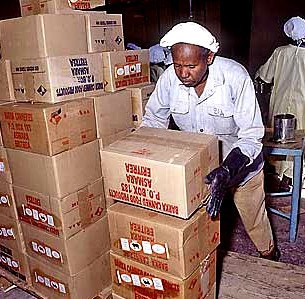
© R Faidutti/FAO/afrol News
Horticultural products from Eritrea being prepared for export markets.
Consumers in Europe are again growing more environmentally conscious and are willing to use their purchasing power to assist in what is widely seen as our era's most pressing problems - the overspending of energy and global warming. Meanwhile, European politicians have been those pressuring strongest to gain support for the Kyoto Protocol while having totally failed to lower emissions of climate gases in their own countries. In every country, emissions have steadily increased.
Populist solutions that are to satisfy costumers, politicians and the European industry alike are therefore surfacing all over Africa's neighbour continent and the main market of its products. And the solutions seem neat and nice - easy to understand and with the potential of creating more work locally. Even the industry starts propagating these solutions.
The victim mainly is Africa, because the message is that, as longer as a product or person is transported, the more energy is wasted unnecessarily. Worst of all is airborne transport, having the highest emissions of climate gases such as CO2. Unluckily, Africa is far away from European markets and poor transcontinental infrastructure puts most products and travellers on an airplane.
All over Europe, therefore, home-grown campaigns are being promoted, attacking Africa's newest and most successful export products. Anti-globalisation activists, "green" politicians, local industry and even occasional experts and scientists head these "buy local" campaigns.
One of the latest campaigns is being launched in Germany, Europe's most populous state and biggest single market. The campaign goes "Sylt instead of Seychelles", referring to a fragile German North Sea island with an overstretched and environmentally damaging tourism industry. Tourism and climate expert Dr Manfred Stock developed the slogan and told the daily newspaper 'Berliner Zeitung' that consumers worrying about global warming should avoid intercontinental flights and rather take the train to a German or European destination.
The much-quoted researcher is in line with policies promoted by Germany's Federal Environment Agency (UBA). UBA President Dr Andreas Troge has made the climate change issue his agency's foremost focus, and one of the ways consumers could "do something on your own" is by changing their travel behaviour, UBA says. A single traveller flying to an intercontinental destination produces more than five tonnes of CO2, he told the German press, while someone travelling by train within Germany only had the emission of ten of kilograms of CO2 to account for.
Some even go further and have started penalising air travellers. In Norway, flyers have started paying for their CO2 emissions. So far, only domestic flights are penalised to make sure Norwegian airliners are not losing out in competition with other companies on international flights. But Norway is among many countries working for a CO2 tax on world-wide flights, which of course in particular would make long distance flights much more expensive.
This comes as most African states are investing massively in their nascent tourism industry and as Africa is surfacing as a modern and exciting travel destination in most Western markets. Some sub-Saharan states, in particular Seychelles, Mauritius, Cape Verde and The Gambia, already see tourism as their greatest foreign exchange earners. In Kenya, Tanzania, Senegal, Namibia, Botswana and South Africa, the travel industry by now is a vibrant success, while newcomers as Mozambique, Ethiopia, Gabon and Burkina Faso pin great investments and development hopes to the industry.
Ironically, much of Africa's new tourist destinations are focusing on eco-tourism, searching for modes that can guarantee the protection and good management of wildlife and habitats and local community development based on the new tourism revenues. In Gabon and Madagascar, vast landscapes have bee protected to be able to promote eco-tourism. No measure in African history has proven so successful in stopping tree cutting and forest conservation than prospects of tourism revenues.
Mature markets like Seychelles, Mauritius and South Africa are already world leaders when it comes to conservation and management, knowing that their tourism industry depends on a sound nature.
At the same time, African destinations like Seychelles are demonised as anti-environmental by European "experts". If successful, these campaigns could have a severe effect on the European market, which for the first time is experiencing a positive image of Africa as a must-see travel destination.
But also other African success stories are threatened by this new "stay local" trend. During the last decade, African agricultural products are increasingly admitted into the protectionist European market, even when also produced in Europe. This includes beef from Namibia and Botswana, fresh flowers, fruit and vegetables from Kenya and even processed food products from South Africa and Ghana.
None of the few African countries that have managed to enter European markets with agricultural products that compete with local producers have had an easy path reaching their position. Food quality and hygiene standards in Europe are extremely rigid and to a large degree designed to exclude foreign competition. To be able to reach sceptical European consumers, African producers mostly also have been obliged to follow strict environmental and social guidelines.
Also, African food products for years had to fight against false prototypes promoted by seemingly well-meaning anti-globalisation activists that to a great degree were funded by local farmer organisations. Development specialists - who do not get much air-time in European media - had to explain on and on again that European consumers were not "stealing food from starving Africans" when buying their products, but that these imports indeed would promote wealth and empowerment in rural Africa.
But in country after country, also these hard-bought gains are now under attack. Britain is the country where consumers so far have had the strongest focus on how far the food basket has travelled before reaching supermarkets. "Fresh vegetables from Africa" have for several years been one of the main focuses of environmental and anti-globalisation activists. They have even produced research claiming that the further foods have travelled, "the more their vitamin and mineral content deteriorates."
Already in 2003, airlifted baby carrots and garden peas from South Africa were highlighted in energy budgets of imported foods. For carrots, "it will have taken 68 calories of energy in the form of fuel to air freight each calorie of carrot energy," while "fresh peas require approximately two and half times the energy to produce, package and distribute as those sourced locally," the British daily 'Guardian' reported. South African wine, which is mostly shipped, however was praised for its "tiny" CO2 emissions. Of all the African products scrutinised, only wine is not produced Britain.
Years of campaigning against African agricultural products in the UK - whose funding has yet to be revealed - has already left its mark on British consumers. The easy-selling "fact" that locally produced vegetables, meat, flowers and fruits are more environmentally fit than African imports has made many consumers look for "low emission products".
That this trend is significant was demonstrated by a surprise marketing campaign by Britain's largest supermarket chain, Tesco, in February 2007. The retailer was to introduce "carbon counting" labelling to let consumers see for themselves how far their food basket had travelled and how much CO2 emissions had been needed.
Tesco is one of the main channels for Kenyan products to European consumers - indeed half of Kenya's agricultural exports go to Britain. Naturally, the surprise marketing stunt caused frustrations at the Fresh Produce Exporters Association of Kenya (FPEAK), which had not been consulted on the move. While Tesco promised to keep on importing Kenyan products, "carbon counting" labels on these goods from 2008 will tell a one-sided story to British consumers.
From Britain, this trend is spreading to all over Western Europe. In Sweden, the leading daily 'Aftonbladet' attacked local supermarkets for not following Tesco's example "despite the fact that one fourth of climate gases emitted by Swedes originate from our food." Ecologist Annika Carlsson-Kanyama enthusiastically helped the Swedish daily to make a parallel guide for consumers, where "airborne tropical fruits" were labelled as no-goes for conscious consumers.
In other countries, old arguments against food imports from Africa are resurfacing. In the programme of Nature and Youth, one of the environment groups gaining most media attention in Norway, new and old "facts" are mixed: "Locally produced food is more environmental, safe and solidary," it says, claiming solidarity with African producers "for not spending the resources of others." Norway is a main importer of Namibian beef.
While the great focus on "environmentally damaging" food imports from Africa and flights to Africa is even increasing, less and less attention is given to the positive environmental balance of this trade. Forgotten is the fact that almost 100 percent of input factors in African agriculture are locally made and almost no machinery is used in production, while European farmers import fertilisers, pesticides, seeds, seasonal workers and oil-consuming machineries from all over the world.
Forgotten is also the fact that food exports and tourist destination developments empower Africans to protect and manage their environment and even reduce African-induced CO2 emissions. Eco-tourism has greatly promoted the protection of forests, mangroves, savannas and coral reefs in Africa - which also are key environs when it comes to storing CO2. A larger and more diversified food production in Africa also reduces the dependence on imports to supply African consumers.
And the greatest irony of all is that, while imports from Africa again are demonised, exports from Europe to Africa causing the same CO2 emissions are promoted as ever before. Subsidies are paid to promote the consumption of Spanish biscuits, French dairy products, European wheat instead of local staple foods, European tropical fruit juices, trawler caught fish dishes and, of course, all kind of industrial products.
Even Tesco, being concerned about CO2 emissions of transported foods, shows its real face when it comes to exporting from Europe.
Only two weeks before its much-publicised marketing campaign on "carbon counting" labels, the UK retailer issued a less-publicised statement. It announced the opening of ten supermarkets in China, where it will be selling popular European grocery products. Political support in Beijing was bought by promising to buy Chinese products worth euro 3.3 billion annually for exports.
In China, Tesco meets competition from the giant chains Carrefour of France and Metro of Germany, already assuring a European export of products and lifestyle to the world's fastest growing market. Who would come up with a silly idea of starting to count CO2 emissions when Europe's super retailers are taking up competition with America's Wal-Mart, thus promoting French, German and British products among China's 1.3 billion inhabitants?
 |
© R Faidutti/FAO/afrol News
Horticultural products from Eritrea being prepared for export markets.
Consequences of Population Explosion, Global Warming
Saylac - This time around there is a global awareness that the world is facing the challenges of population explosion and global warming that could endanger almost all biological entities in the world.
There is a consensus that the global warming and population explosion is now a significant burden to the environment where biological entities are living.
Last week the Biological Society of Ethiopia, at the opening of its 17th annual conference, picked a central theme: "Population Explosion and Global Warming: Local and Global Context." During a two-day session many scholars presented papers related to the topic.
Dr. Solomon Yirga, president of the Biological Society of Ethiopia, said that the issue of climate change is a headline in almost all kinds of papers and forums, including in business and politics around the world. The impact of global warming can be manifested in various forms of changes in the environment. "For example, hundreds of thousands of our citizens have been victims of the recent flood disaster in Ethiopia and capital-intensive measures were taken to alleviate the problems by the government and the people," he said. Any change in the environment would definitely have negative consequences like droughts, floods and mosquitoes.
Today, he said, the global human population has reached about 6.5 billion. The problem of rapid population growth has assumed critical stage in the least developed countries like Ethiopia. "Unless we create a means to increase production and productivity of the arable land through basic and applied research results, that would minimize effects of global warming and population growth."
The president noted that experience over the last couple of decades in Ethiopia has shows that as human population increases, the carrying capacity of the environment decreases. A high population growth rate induces environmental degradation, increase in demand for resources and the rate at which these resources are exploited.
In Ethiopia, the rate at which agricultural and medical technologies are generated and disseminated to the rural poor is not sufficient enough. However, the research resulted that are formulated in some way and disseminated to end users clearly show that the technologies generated by Ethiopian scientists could have significant contribution towards the improvement in the livelihoods of many of our people Ethiopians. "Such successful results of pilot projects in the area of agriculture, medicine and education would motivate biological scientists towards generating, evaluating and promoting new research results that could change the lives of our society through minimizing effects of environmental factors," he added.
Fisseha Itanna, from the department of biology at the Addis Ababa University (AAU), in his presentation, said that Ethiopia is among the most populated nations in Africa, ranking third after Nigeria and Egypt. Recent annual population growth rate in the country is estimated to be 2.3 percent. It is well understood that increase in population definitely adds to the actively engaged in a taskforce in a community. On the other hand, with increase in population some problems start to be manifested.
According to his observation, one salient feature that commonly occurs is competition among people for limited resources such as land, water and even air. It is also understood, as population increases, that traditional farming and productions systems come under extreme pressure to withstand the needs of the additional mouths. Industrialization and intensification of productive systems then become the only option of nations to come out of this problem.
Fisseha said that thousands after thousands migrate into cities in search of better opportunities from rural communities, thereby accelerating the rate of urbanization in the country. Ethiopia is not an exception to this state of affairs and over the past decades such has been the scenario in this country too. "The major industries in the country are food processing, beverages, textiles, leather, chemicals, metals processing and cement. The industrial production growth rate is estimated at about 6.7 percent."
The scholar said that as processes of industrialization and urbanization continue, degradation of different forms appear in the urban setting. Soil degradation through industrial and urban development is described as sealing, physical, chemical and biological degradation. Sealing of soils occurs through the construction of roads, industrial premises, houses, sporting facilities, and the use of soils as dumping grounds for different kinds of refuse. Agricultural lands, which otherwise could be used for cereal, fruit or vegetable production, or serve as rangelands are converted into roads and housing grounds through sealing.
Reduction of farmlands in urban and sub-urban centers in this manner will consequently result in commensurate crop losses. There are reports that the water from the rivers crossing Addis Ababa was much cleaner before several decades and people even used to drink it. However, he said, with the increase in urban population and industrialization, the water has now become contaminated with organic and inorganic pollutants. With increase in population degradation of the ecosystems takes place at a more rapid rate. Soil degradation through urban activities is mainly due to the enormous consumption of air, water and other goods within towns. Consumption of these products results in the release of huge amounts of solid and liquid wastes in the cities.
With regard to industrial pollution, he said chemical and biological degradation are caused by contamination with inorganic compounds such as heavy metals, as well as organic compounds such as polycyclic aromatic hydrocarbons. The physico-chemical and biological degradation resulting from industrial activities is more concentrated and intense than that from urban activities. These urban and industrial activities in many cases irreversibly reduce the multi-functionary soils. "Under natural conditions, plants, animals and human beings are adapted to the local natural metal concentrations. Increased extraction of heavy metals and use of raw materials and fossil energy since the mid-18th century, however, are now leading to global pollution through atmospheric and water contamination." Population explosion has also impact on the concentration of greenhouse gases in the atmosphere; land use changes could induce emissions of carbon into the atmosphere with a resultant global warming, he added.
Jason O. Onsembe from the United Nations Fund for Population (UNFPA) in his presentation indicated that Ethiopia has an estimated total population of 79.3 million which is expected to be 170.2 million by 2050. "High growth rate of population affects the future size of population, the age structure, labor force supply, rural and urban distribution, regional densities, all of which have implications on development."
Regarding fertility rate, the presenter said that the total fertility rate in Ethiopia is 5.9 which is high by any standard. Only 17 percent of women favor having fewer than four children, and women consider 5.3 children as the average ideal family size. The Ethiopian government considers high rate of population as a great challenge to its objectives of meeting the demands for social services and facilities, particularly in such areas as health, education employment, housing, environmental security and general well-being.
He added that nine counties, one of which is Ethiopia, are expected to account for half of the world's projected population increase during the period 2005-2007; global life expectancy is expected to rise; and the net international migration to more developed regions is projected to reach 98 million during the period 2005-2050. "In Ethiopia, high population growth will impede all efforts aimed at reducing poverty, as the recent analysis of the trends in economic growth, poverty and population dynamics indicate." He suggested that it now remains the responsibility of policymakers to put in place appropriate policies and strategies to change the direction of population growth. In poor counties, massive efforts are required to ensure non-deterioration of social and economic conditions.
Dr. Solomon said the greater understanding of the factors that affect global warming and population growth patterns can help the country plan for the future; the national population policy has been adopted together with several important policy initiatives on natural resource development and environmental protection. The professional societies like Biological Societies of Ethiopia are expected to contribute a lot towards the development of ways and means of reducing pressure. "Then the combined efforts from various stakeholders will be synthesized to produce packages that could be promoted to the societies and policy makers for possible interventions."
There is a consensus that the global warming and population explosion is now a significant burden to the environment where biological entities are living.
Last week the Biological Society of Ethiopia, at the opening of its 17th annual conference, picked a central theme: "Population Explosion and Global Warming: Local and Global Context." During a two-day session many scholars presented papers related to the topic.
Dr. Solomon Yirga, president of the Biological Society of Ethiopia, said that the issue of climate change is a headline in almost all kinds of papers and forums, including in business and politics around the world. The impact of global warming can be manifested in various forms of changes in the environment. "For example, hundreds of thousands of our citizens have been victims of the recent flood disaster in Ethiopia and capital-intensive measures were taken to alleviate the problems by the government and the people," he said. Any change in the environment would definitely have negative consequences like droughts, floods and mosquitoes.
Today, he said, the global human population has reached about 6.5 billion. The problem of rapid population growth has assumed critical stage in the least developed countries like Ethiopia. "Unless we create a means to increase production and productivity of the arable land through basic and applied research results, that would minimize effects of global warming and population growth."
The president noted that experience over the last couple of decades in Ethiopia has shows that as human population increases, the carrying capacity of the environment decreases. A high population growth rate induces environmental degradation, increase in demand for resources and the rate at which these resources are exploited.
In Ethiopia, the rate at which agricultural and medical technologies are generated and disseminated to the rural poor is not sufficient enough. However, the research resulted that are formulated in some way and disseminated to end users clearly show that the technologies generated by Ethiopian scientists could have significant contribution towards the improvement in the livelihoods of many of our people Ethiopians. "Such successful results of pilot projects in the area of agriculture, medicine and education would motivate biological scientists towards generating, evaluating and promoting new research results that could change the lives of our society through minimizing effects of environmental factors," he added.
Fisseha Itanna, from the department of biology at the Addis Ababa University (AAU), in his presentation, said that Ethiopia is among the most populated nations in Africa, ranking third after Nigeria and Egypt. Recent annual population growth rate in the country is estimated to be 2.3 percent. It is well understood that increase in population definitely adds to the actively engaged in a taskforce in a community. On the other hand, with increase in population some problems start to be manifested.
According to his observation, one salient feature that commonly occurs is competition among people for limited resources such as land, water and even air. It is also understood, as population increases, that traditional farming and productions systems come under extreme pressure to withstand the needs of the additional mouths. Industrialization and intensification of productive systems then become the only option of nations to come out of this problem.
Fisseha said that thousands after thousands migrate into cities in search of better opportunities from rural communities, thereby accelerating the rate of urbanization in the country. Ethiopia is not an exception to this state of affairs and over the past decades such has been the scenario in this country too. "The major industries in the country are food processing, beverages, textiles, leather, chemicals, metals processing and cement. The industrial production growth rate is estimated at about 6.7 percent."
The scholar said that as processes of industrialization and urbanization continue, degradation of different forms appear in the urban setting. Soil degradation through industrial and urban development is described as sealing, physical, chemical and biological degradation. Sealing of soils occurs through the construction of roads, industrial premises, houses, sporting facilities, and the use of soils as dumping grounds for different kinds of refuse. Agricultural lands, which otherwise could be used for cereal, fruit or vegetable production, or serve as rangelands are converted into roads and housing grounds through sealing.
Reduction of farmlands in urban and sub-urban centers in this manner will consequently result in commensurate crop losses. There are reports that the water from the rivers crossing Addis Ababa was much cleaner before several decades and people even used to drink it. However, he said, with the increase in urban population and industrialization, the water has now become contaminated with organic and inorganic pollutants. With increase in population degradation of the ecosystems takes place at a more rapid rate. Soil degradation through urban activities is mainly due to the enormous consumption of air, water and other goods within towns. Consumption of these products results in the release of huge amounts of solid and liquid wastes in the cities.
With regard to industrial pollution, he said chemical and biological degradation are caused by contamination with inorganic compounds such as heavy metals, as well as organic compounds such as polycyclic aromatic hydrocarbons. The physico-chemical and biological degradation resulting from industrial activities is more concentrated and intense than that from urban activities. These urban and industrial activities in many cases irreversibly reduce the multi-functionary soils. "Under natural conditions, plants, animals and human beings are adapted to the local natural metal concentrations. Increased extraction of heavy metals and use of raw materials and fossil energy since the mid-18th century, however, are now leading to global pollution through atmospheric and water contamination." Population explosion has also impact on the concentration of greenhouse gases in the atmosphere; land use changes could induce emissions of carbon into the atmosphere with a resultant global warming, he added.
Jason O. Onsembe from the United Nations Fund for Population (UNFPA) in his presentation indicated that Ethiopia has an estimated total population of 79.3 million which is expected to be 170.2 million by 2050. "High growth rate of population affects the future size of population, the age structure, labor force supply, rural and urban distribution, regional densities, all of which have implications on development."
Regarding fertility rate, the presenter said that the total fertility rate in Ethiopia is 5.9 which is high by any standard. Only 17 percent of women favor having fewer than four children, and women consider 5.3 children as the average ideal family size. The Ethiopian government considers high rate of population as a great challenge to its objectives of meeting the demands for social services and facilities, particularly in such areas as health, education employment, housing, environmental security and general well-being.
He added that nine counties, one of which is Ethiopia, are expected to account for half of the world's projected population increase during the period 2005-2007; global life expectancy is expected to rise; and the net international migration to more developed regions is projected to reach 98 million during the period 2005-2050. "In Ethiopia, high population growth will impede all efforts aimed at reducing poverty, as the recent analysis of the trends in economic growth, poverty and population dynamics indicate." He suggested that it now remains the responsibility of policymakers to put in place appropriate policies and strategies to change the direction of population growth. In poor counties, massive efforts are required to ensure non-deterioration of social and economic conditions.
Dr. Solomon said the greater understanding of the factors that affect global warming and population growth patterns can help the country plan for the future; the national population policy has been adopted together with several important policy initiatives on natural resource development and environmental protection. The professional societies like Biological Societies of Ethiopia are expected to contribute a lot towards the development of ways and means of reducing pressure. "Then the combined efforts from various stakeholders will be synthesized to produce packages that could be promoted to the societies and policy makers for possible interventions."
Thursday, March 15, 2007
United Arab Emirates Consume More Energy Than U.S.
AP - When it comes to squandering the earth's natural resources, residents of this desert land of chilled swimming pools, monster 4x4s and air-conditioned malls are on a par with even the ravenous consumption of Americans, according to the World Wildlife Fund.
The average person in the Emirates puts more demand on the global ecosystem than any other, giving the country the world's largest per-capita "ecological footprint," WWF data shows. The United States runs second.
But the oil-rich Emirates is considered a developing country, and even as a signatory to the United Nations' Kyoto protocol on global warming, is not required to cut emissions. The United States is not bound by Kyoto.
Even so, the Emirates government has been embarrassed by the WWF report, which it says is flawed. The federal environment agency is devising strategies to cut emissions, including a public campaign that may offer economic incentives to those who turn down their air conditioning, said Saad al-Numairy, an adviser to the agency.
"We have an action plan," al-Numairy said. "But we are a multicultural country with 180 nationalities. It's not going to be easy."
Energy consumption in the Emirates runs high for many of the same reasons found in the United States: a feeling that the good life requires huge air-conditioned houses and cars, and a disdain for public transportation.
Making matters worse are Dubai's audacious developments, including artificial resort islands that have destroyed coral reefs and an indoor ski slope that still creates snow when it is 120 degrees outside.
"Of all the places to make artificial snow, this has to be the most absurd," said Jonathan Loh, a British biologist who co-authored the WWF report.
Nearby Kuwait, another scorching-hot Persian Gulf oil producer, ranked fifth in the WWF report. Finland was third and Canada fourth.
Environmental officials here say the Emirates ranking is based on outdated information, since the WWF report relies on 2003 data that estimates the country's population at 3 million when it is closer to 5 million.
"It's a fact of life that the UAE will always have a large ecological footprint because of where we are," said Habiba al-Marashi, who chairs the Emirates Environmental Group. "But to be classified as the worst, that hurts. We don't think the report is on solid ground."
Loh acknowledged that factoring in more accurate population figures might put UAE in second place just behind the United States, but "it's still going to show that the UAE is right on the top of the scale."
The country's full damage is not tallied because the WWF study ignores aircraft emissions, Loh said. The UAE emirate of Dubai claims one of the world's busiest airports.
The WWF rankings are measured in "global hectares" - the area of biologically productive land and sea needed to provide the resources consumed by an average person. The Emirates' ecological footprint measured 11.9 global hectares per person, compared to 9.6 hectares per person for the United States and a global average of 2.2 hectares a person.
The country took the top spot because its energy consumption is high and emissions are spread among a small population, Loh said.
The country's landscape offers little help. Undulating sand dunes and jagged mountains of bare rock offer precious little greenery to soak up carbon emissions.
One focal point for Dubai's emissions is the red-and-white smokestacks jutting from gas-fired power plants and an aluminum smelter that line the beach on the city's outskirts. The plants do double duty distilling fresh water from Gulf seawater, an energy-intensive process that accounts for 98 percent of the fresh water in a country with no rivers and little usable groundwater.
In Dubai and Abu Dhabi desalinated water is lavished, Las Vegas-style, on fountains, artificial lakes, swimming pools, resort greenery and golf courses sitting atop once drifting desert sands. Desalination also produces most fresh water in Saudi Arabia and Kuwait, Gulf countries that also showed high footprints.
Due to the country's small size, carbon emissions and consumption in the Emirates are a tiny fraction of that of the United States, and Loh said most efforts to cut greenhouse gases need to concentrate on America and other large industrial countries.
But unlike in the United States, energy consumption has not emerged as an issue. The Emirates, like the rest of the oil-producing Gulf states, was until the 1960s an impoverished desert country whose residents survived through subsistence fishing, farming and small-time trade.
Now, the government's energy subsidies give Emirates citizens free water and cheap electricity. Gasoline sells for around $1.70 per gallon.
"Really, we're happy to be rich now," said Majid al-Mansouri, who heads the environment agency serving Abu Dhabi.
The WWF has asked the Emirates government to cut energy use and move toward renewable energy, especially solar power viable in one of the world's sunniest climates.
Al-Mansouri said the country was looking to make improvements, such as running publicly owned vehicles on compressed natural gas - which is cleaner burning but still emits globe-warming carbon dioxide. The state oil company has eliminated 80 percent of its wasteful flaring off of natural gas at oil wellheads, he said.
Other projects once considered environmentally friendly here are being re-evaluated.
***

Nakheel via AP
ILLUSTRATION OF 'THE WORLD' ISLANDS
This illustration shows that "The World," a collection of 300 man-made islands off the United Arab Emirates, is intended to look like its name when completed by 2008. More on MSNBC.
The average person in the Emirates puts more demand on the global ecosystem than any other, giving the country the world's largest per-capita "ecological footprint," WWF data shows. The United States runs second.
But the oil-rich Emirates is considered a developing country, and even as a signatory to the United Nations' Kyoto protocol on global warming, is not required to cut emissions. The United States is not bound by Kyoto.
Even so, the Emirates government has been embarrassed by the WWF report, which it says is flawed. The federal environment agency is devising strategies to cut emissions, including a public campaign that may offer economic incentives to those who turn down their air conditioning, said Saad al-Numairy, an adviser to the agency.
"We have an action plan," al-Numairy said. "But we are a multicultural country with 180 nationalities. It's not going to be easy."
Energy consumption in the Emirates runs high for many of the same reasons found in the United States: a feeling that the good life requires huge air-conditioned houses and cars, and a disdain for public transportation.
Making matters worse are Dubai's audacious developments, including artificial resort islands that have destroyed coral reefs and an indoor ski slope that still creates snow when it is 120 degrees outside.
"Of all the places to make artificial snow, this has to be the most absurd," said Jonathan Loh, a British biologist who co-authored the WWF report.
Nearby Kuwait, another scorching-hot Persian Gulf oil producer, ranked fifth in the WWF report. Finland was third and Canada fourth.
Environmental officials here say the Emirates ranking is based on outdated information, since the WWF report relies on 2003 data that estimates the country's population at 3 million when it is closer to 5 million.
"It's a fact of life that the UAE will always have a large ecological footprint because of where we are," said Habiba al-Marashi, who chairs the Emirates Environmental Group. "But to be classified as the worst, that hurts. We don't think the report is on solid ground."
Loh acknowledged that factoring in more accurate population figures might put UAE in second place just behind the United States, but "it's still going to show that the UAE is right on the top of the scale."
The country's full damage is not tallied because the WWF study ignores aircraft emissions, Loh said. The UAE emirate of Dubai claims one of the world's busiest airports.
The WWF rankings are measured in "global hectares" - the area of biologically productive land and sea needed to provide the resources consumed by an average person. The Emirates' ecological footprint measured 11.9 global hectares per person, compared to 9.6 hectares per person for the United States and a global average of 2.2 hectares a person.
The country took the top spot because its energy consumption is high and emissions are spread among a small population, Loh said.
The country's landscape offers little help. Undulating sand dunes and jagged mountains of bare rock offer precious little greenery to soak up carbon emissions.
One focal point for Dubai's emissions is the red-and-white smokestacks jutting from gas-fired power plants and an aluminum smelter that line the beach on the city's outskirts. The plants do double duty distilling fresh water from Gulf seawater, an energy-intensive process that accounts for 98 percent of the fresh water in a country with no rivers and little usable groundwater.
In Dubai and Abu Dhabi desalinated water is lavished, Las Vegas-style, on fountains, artificial lakes, swimming pools, resort greenery and golf courses sitting atop once drifting desert sands. Desalination also produces most fresh water in Saudi Arabia and Kuwait, Gulf countries that also showed high footprints.
Due to the country's small size, carbon emissions and consumption in the Emirates are a tiny fraction of that of the United States, and Loh said most efforts to cut greenhouse gases need to concentrate on America and other large industrial countries.
But unlike in the United States, energy consumption has not emerged as an issue. The Emirates, like the rest of the oil-producing Gulf states, was until the 1960s an impoverished desert country whose residents survived through subsistence fishing, farming and small-time trade.
Now, the government's energy subsidies give Emirates citizens free water and cheap electricity. Gasoline sells for around $1.70 per gallon.
"Really, we're happy to be rich now," said Majid al-Mansouri, who heads the environment agency serving Abu Dhabi.
The WWF has asked the Emirates government to cut energy use and move toward renewable energy, especially solar power viable in one of the world's sunniest climates.
Al-Mansouri said the country was looking to make improvements, such as running publicly owned vehicles on compressed natural gas - which is cleaner burning but still emits globe-warming carbon dioxide. The state oil company has eliminated 80 percent of its wasteful flaring off of natural gas at oil wellheads, he said.
Other projects once considered environmentally friendly here are being re-evaluated.
***
Nakheel via AP
ILLUSTRATION OF 'THE WORLD' ISLANDS
This illustration shows that "The World," a collection of 300 man-made islands off the United Arab Emirates, is intended to look like its name when completed by 2008. More on MSNBC.
Introducing the Nation's First Solar-Hydrogen House
The Christian Science Monitor -- Mike Strizki lives in the nation's first solar-hydrogen house. The technology this civil engineer has been able to string together – solar panels, a hydrogen fuel cell, storage tanks, and a piece of equipment called an electrolyzer – provides electricity to his home year-round, even on the cloudiest of winter days.
Mr. Strizki's monthly utility bill is zero – he's off the power grid – and his system creates no carbon-dioxide emissions. Neither does the fuel-cell car parked in his garage, which runs off the hydrogen his system creates.
It sounds promising, even utopian: homemade, storable energy that doesn't contribute to global warming. But does Strizki's method – converting electricity generated from renewable sources into hydrogen – make sense for widespread adoption?
According to some renewable-energy experts, the answer is "no," at least not anytime soon. The system is too expensive, they say, and the process of creating hydrogen from clean sources is itself laced with inefficiency – the numbers just don't add up.
Strizki's response: "Nothing is as wildly expensive as destroying the whole planet."
Life free from the power grid
Strizki lives with his wife in a rural section of Central New Jersey. His 12-acre property is surrounded by trees and his gravel driveway leads to a winding country road. His 3,500-square-foot house has all the amenities, including a hot tub and a big-screen TV.
It was here, four years ago, that Strizki set out to do something that's never been done in this country – power his home completely through a combination of solar and hydrogen. "My motivation was, I saw what fossil fuels were doing to the environment," he says.
Strizki works for a company that installs solar panels. In previous jobs, he's helped integrate hydrogen fuel cells into cars, a boat, a fire truck, and an airplane. His latest project, the one involving his house, is an extension of that expertise.
The solar-hydrogen house took longer to complete than Strizki expected – a strict local zoning officer and the state permitting process caused delays, he says – but in October 2006, the system finally went online. The total cost, $500,000, was paid for in part with a $250,000 grant from the New Jersey Board of Public Utilities.
This is how it works
On sunny days, solar panels on the roof of Strizki's detached garage generate more than enough electricity to power his home. The excess electricity powers a device inside the garage called an electrolyzer, which transforms a tank of water into its base elements – oxygen and hydrogen.
The oxygen is released into the atmosphere, while the hydrogen is stored in 10 1,000-gallon propane tanks on Strizki's property. In the winter, when the solar panels collect less energy than the home needs, that hydrogen is piped to an air-conditioner-size fuel cell, located just outside the garage, which generates electricity.
The final piece of the equation is "The New Jersey Genesis," a hydrogen fuel-cell car Strizki helped design and now maintains for the New Jersey Department of Transportation. He can fill up the Genesis with hydrogen from his electrolyzer and drive it pollution free.
Strizki understands that few people can afford to pay hundreds of thousands of dollars for clean energy. Now that he's demonstrated his idea works, his goal is to make the system better and less expensive. (For example, the 10 propane tanks could be replaced by one high-pressure hydrogen tank buried underground.) With mass production, he believes he could get the price of the system, not including the solar panels, down to about $50,000. (A new solar panel system can cost as much as $80,000, Strizki says, but some states, including New Jersey, have offered rebates that cover up to 70 percent of the cost.) Strizki is seeking government grants and private donors for funding, and he's started a company, Renewable Energy International, which he hopes will one day market his product. He says he's already heard from potential customers: "We've been called by some A-list Hollywood types interested in powering their islands."
Hydrogen hurdles
Strizki's project proves that carbon-free living is possible right now, but renewable-energy experts are skeptical that hydrogen houses with hydrogen-run cars in the driveway will catch on anytime soon.
"There's no way your average person is going to want to buy five expensive pieces of hardware," says Joseph Romm, a former
Department of Energy official who analyzed clean-energy technologies during the Clinton administration.
In addition to the high cost of the equipment, there's another huge hurdle that must be overcome if hydrogen is to become a viable clean energy: Although hydrogen is the most abundant element in the universe, it doesn't exist alone in nature; you can't just bottle it up.
To get at hydrogen, it must be processed from another source, such as natural gas, oil, coal, or water. According to the National Hydrogen Association, 95 percent of the hydrogen produced in the United States is made through steam reforming natural gas – a process that releases greenhouse gases into the air.
Strizki's method for making hydrogen is totally clean, but suffers from a different problem: Electrolyzers are only 50 percent efficient. By the time the electricity from his solar panels is converted into hydrogen, and the hydrogen converted back into electricity in the fuel cell, half of the clean energy he started with is used up.
Mr. Romm thinks it's a waste. That electricity would do more good toward reducing pollution if it was sent into the main power grid to displace other energy, he says. "[Strizki's system] doesn't get you that much environmentally," he says.
Romm is an advocate for clean-energy use – in recent books and articles he advocates a sharp cut in greenhouse-gas emissions within 10 years – but he's characterized hydrogen as an overhyped distraction that isn't ready yet to help toward that goal. He supports continued hydrogen research, but other technologies that are more developed could help the Earth much more and much sooner, he says.
Not ready for prime time
Robert Boehm, director of the Center for Energy Research at the University of Nevada, Las Vegas, has studied renewable energy for the past 35 years. His reaction to Strizki's home project is tempered.
"Does it make sense in the present environment? Probably not. Does it make sense as a sustainable thing in the future? It very well could," Dr. Boehm says.
Boehm predicts that it will be at least a decade before hydrogen energy is ready for the mainstream, and then only if enough money is put into research and development.
"In any of these new technologies, they need a lot of government support," he says.
Boehm sees the most immediate potential for a system like Strizki's in places far from a power grid, where selling renewable energy back to a power company is not an option.
Strizki isn't dissuaded by criticisms that his system is too expensive or too inefficient to be practical. He's determined to push technology ahead toward an end goal – totally clean energy – and he sees renewable hydrogen as the best solution.
"It's the way that makes the most sense, and we have to start somewhere," he says. "If you look at it, no one has said what I'm doing doesn't work."
Mr. Strizki's monthly utility bill is zero – he's off the power grid – and his system creates no carbon-dioxide emissions. Neither does the fuel-cell car parked in his garage, which runs off the hydrogen his system creates.
It sounds promising, even utopian: homemade, storable energy that doesn't contribute to global warming. But does Strizki's method – converting electricity generated from renewable sources into hydrogen – make sense for widespread adoption?
According to some renewable-energy experts, the answer is "no," at least not anytime soon. The system is too expensive, they say, and the process of creating hydrogen from clean sources is itself laced with inefficiency – the numbers just don't add up.
Strizki's response: "Nothing is as wildly expensive as destroying the whole planet."
Life free from the power grid
Strizki lives with his wife in a rural section of Central New Jersey. His 12-acre property is surrounded by trees and his gravel driveway leads to a winding country road. His 3,500-square-foot house has all the amenities, including a hot tub and a big-screen TV.
It was here, four years ago, that Strizki set out to do something that's never been done in this country – power his home completely through a combination of solar and hydrogen. "My motivation was, I saw what fossil fuels were doing to the environment," he says.
Strizki works for a company that installs solar panels. In previous jobs, he's helped integrate hydrogen fuel cells into cars, a boat, a fire truck, and an airplane. His latest project, the one involving his house, is an extension of that expertise.
The solar-hydrogen house took longer to complete than Strizki expected – a strict local zoning officer and the state permitting process caused delays, he says – but in October 2006, the system finally went online. The total cost, $500,000, was paid for in part with a $250,000 grant from the New Jersey Board of Public Utilities.
This is how it works
On sunny days, solar panels on the roof of Strizki's detached garage generate more than enough electricity to power his home. The excess electricity powers a device inside the garage called an electrolyzer, which transforms a tank of water into its base elements – oxygen and hydrogen.
The oxygen is released into the atmosphere, while the hydrogen is stored in 10 1,000-gallon propane tanks on Strizki's property. In the winter, when the solar panels collect less energy than the home needs, that hydrogen is piped to an air-conditioner-size fuel cell, located just outside the garage, which generates electricity.
The final piece of the equation is "The New Jersey Genesis," a hydrogen fuel-cell car Strizki helped design and now maintains for the New Jersey Department of Transportation. He can fill up the Genesis with hydrogen from his electrolyzer and drive it pollution free.
Strizki understands that few people can afford to pay hundreds of thousands of dollars for clean energy. Now that he's demonstrated his idea works, his goal is to make the system better and less expensive. (For example, the 10 propane tanks could be replaced by one high-pressure hydrogen tank buried underground.) With mass production, he believes he could get the price of the system, not including the solar panels, down to about $50,000. (A new solar panel system can cost as much as $80,000, Strizki says, but some states, including New Jersey, have offered rebates that cover up to 70 percent of the cost.) Strizki is seeking government grants and private donors for funding, and he's started a company, Renewable Energy International, which he hopes will one day market his product. He says he's already heard from potential customers: "We've been called by some A-list Hollywood types interested in powering their islands."
Hydrogen hurdles
Strizki's project proves that carbon-free living is possible right now, but renewable-energy experts are skeptical that hydrogen houses with hydrogen-run cars in the driveway will catch on anytime soon.
"There's no way your average person is going to want to buy five expensive pieces of hardware," says Joseph Romm, a former
Department of Energy official who analyzed clean-energy technologies during the Clinton administration.
In addition to the high cost of the equipment, there's another huge hurdle that must be overcome if hydrogen is to become a viable clean energy: Although hydrogen is the most abundant element in the universe, it doesn't exist alone in nature; you can't just bottle it up.
To get at hydrogen, it must be processed from another source, such as natural gas, oil, coal, or water. According to the National Hydrogen Association, 95 percent of the hydrogen produced in the United States is made through steam reforming natural gas – a process that releases greenhouse gases into the air.
Strizki's method for making hydrogen is totally clean, but suffers from a different problem: Electrolyzers are only 50 percent efficient. By the time the electricity from his solar panels is converted into hydrogen, and the hydrogen converted back into electricity in the fuel cell, half of the clean energy he started with is used up.
Mr. Romm thinks it's a waste. That electricity would do more good toward reducing pollution if it was sent into the main power grid to displace other energy, he says. "[Strizki's system] doesn't get you that much environmentally," he says.
Romm is an advocate for clean-energy use – in recent books and articles he advocates a sharp cut in greenhouse-gas emissions within 10 years – but he's characterized hydrogen as an overhyped distraction that isn't ready yet to help toward that goal. He supports continued hydrogen research, but other technologies that are more developed could help the Earth much more and much sooner, he says.
Not ready for prime time
Robert Boehm, director of the Center for Energy Research at the University of Nevada, Las Vegas, has studied renewable energy for the past 35 years. His reaction to Strizki's home project is tempered.
"Does it make sense in the present environment? Probably not. Does it make sense as a sustainable thing in the future? It very well could," Dr. Boehm says.
Boehm predicts that it will be at least a decade before hydrogen energy is ready for the mainstream, and then only if enough money is put into research and development.
"In any of these new technologies, they need a lot of government support," he says.
Boehm sees the most immediate potential for a system like Strizki's in places far from a power grid, where selling renewable energy back to a power company is not an option.
Strizki isn't dissuaded by criticisms that his system is too expensive or too inefficient to be practical. He's determined to push technology ahead toward an end goal – totally clean energy – and he sees renewable hydrogen as the best solution.
"It's the way that makes the most sense, and we have to start somewhere," he says. "If you look at it, no one has said what I'm doing doesn't work."
Wednesday, March 14, 2007
'Fair Trade' Food Booming in Britain
Christian Science Monitor - In a quiet church vestibule on the southern edge of London, they're doing brisk business. Customers are digging out change for tea bags and cookies. Bags of coffee are being snapped up as if they were the last in town.
"It's only the second year we've done this, but it's really taking off," says Nova Smith, a church volunteer who helps organize the sale of "fair-trade" items. "People are more and more interested in fair trade."
Data show that Britons are avidly buying fair-trade groceries, organic foods, and sustainably farmed produce. Experts speak of a cultural shift in which foodstuffs once considered niche and expensive are now going mainstream.
"They've gone from the margins to the mainstream quite fast," says Professor Tim Lang, an expert in food policy at London's City University. He says the reasons are manifold: good campaigning, globalization, and "large problems that have come into the public arena, like water shortages, adulteration of foods, pollution, contamination, and public-health problems."
In recent months, evidence of this quiet food revolution has multiplied. Supermarkets and major retailers are rapidly expanding their fair-trade offerings such that there are now 1,500 different fair-trade goods on the market. Sales reached more than $500 million last year, up 46 percent from the previous year. Last month, one leading supermarket, Sainsbury, said all its bananas would now be fair-trade. Tea and coffee in another leading retailer, Marks and Spencer, is now exclusively fair-trade.
Purveyors of organic (chemical-free) foods report strong growth as well. Sales of more than $1.9 billion annually (out of a total national grocery turnover of around $135 billion) are growing at 30 percent a year in England. A recent survey by the Oxfam charity, a proponent of fair trade, found that two-thirds of shoppers had refused to buy something because its producer was associated with unethical practices.
"It's part of a whole change of mood around the way we want to live our lives," says Helen Browning, food and farming director of the Soil Association, a charity promoting sustainable farming. "There's a recognition that the consumer society and values of the 1980s have worn thin, and people are looking for something more real."
Or, as Smith puts it: "People feel it's a small thing they can do to make a difference. You can't change the world, but you can do a little bit that helps."
Of course, Britain is not alone. Organic food is popular in other European countries such as Germany, where sales outstrip those in Britain. Organic retail sales in the US have grown more than 20 percent each year since 1990.
In Britain, organic farmers now find it much easier to make a living than non-organic farmers, says Ms. Browning.
"The tipping point came when we started getting retailers doing 100-percent [fair trade] for certain products," says Barbara Crowther of the Fairtrade Foundation, the British member of Fairtrade Labelling Organizations International (FLO). "In terms of volume and range of product available to the consumer, the UK is the world's leader," she says. "Fair trade can help farmers who can see they can get even more value from their crop. It can give them a stability of income."
Some have argued that ethical food is a new type of status symbol, a hallmark of the affluent society with time on its hands.
But academics say the evidence shows that ethical food is not limited to a class or sector of society.
"There is strong evidence that [fair trade] has a cross-class appeal," says Mr. Lang.
Elizabeth Dowler, a food expert at Warwick University, agrees that it is not merely a manifestation of the modern affluent society. "The 'counterculture' movement has a long history, as does a concern for the social and economic local well-being," she says. "The food-retailing sector argues that affluence plays a part – people have the leisure and capacity to indulge in that which is not 'essential.' I think this is too limited a view."
"It's only the second year we've done this, but it's really taking off," says Nova Smith, a church volunteer who helps organize the sale of "fair-trade" items. "People are more and more interested in fair trade."
Data show that Britons are avidly buying fair-trade groceries, organic foods, and sustainably farmed produce. Experts speak of a cultural shift in which foodstuffs once considered niche and expensive are now going mainstream.
"They've gone from the margins to the mainstream quite fast," says Professor Tim Lang, an expert in food policy at London's City University. He says the reasons are manifold: good campaigning, globalization, and "large problems that have come into the public arena, like water shortages, adulteration of foods, pollution, contamination, and public-health problems."
In recent months, evidence of this quiet food revolution has multiplied. Supermarkets and major retailers are rapidly expanding their fair-trade offerings such that there are now 1,500 different fair-trade goods on the market. Sales reached more than $500 million last year, up 46 percent from the previous year. Last month, one leading supermarket, Sainsbury, said all its bananas would now be fair-trade. Tea and coffee in another leading retailer, Marks and Spencer, is now exclusively fair-trade.
Purveyors of organic (chemical-free) foods report strong growth as well. Sales of more than $1.9 billion annually (out of a total national grocery turnover of around $135 billion) are growing at 30 percent a year in England. A recent survey by the Oxfam charity, a proponent of fair trade, found that two-thirds of shoppers had refused to buy something because its producer was associated with unethical practices.
"It's part of a whole change of mood around the way we want to live our lives," says Helen Browning, food and farming director of the Soil Association, a charity promoting sustainable farming. "There's a recognition that the consumer society and values of the 1980s have worn thin, and people are looking for something more real."
Or, as Smith puts it: "People feel it's a small thing they can do to make a difference. You can't change the world, but you can do a little bit that helps."
Of course, Britain is not alone. Organic food is popular in other European countries such as Germany, where sales outstrip those in Britain. Organic retail sales in the US have grown more than 20 percent each year since 1990.
In Britain, organic farmers now find it much easier to make a living than non-organic farmers, says Ms. Browning.
"The tipping point came when we started getting retailers doing 100-percent [fair trade] for certain products," says Barbara Crowther of the Fairtrade Foundation, the British member of Fairtrade Labelling Organizations International (FLO). "In terms of volume and range of product available to the consumer, the UK is the world's leader," she says. "Fair trade can help farmers who can see they can get even more value from their crop. It can give them a stability of income."
Some have argued that ethical food is a new type of status symbol, a hallmark of the affluent society with time on its hands.
But academics say the evidence shows that ethical food is not limited to a class or sector of society.
"There is strong evidence that [fair trade] has a cross-class appeal," says Mr. Lang.
Elizabeth Dowler, a food expert at Warwick University, agrees that it is not merely a manifestation of the modern affluent society. "The 'counterculture' movement has a long history, as does a concern for the social and economic local well-being," she says. "The food-retailing sector argues that affluence plays a part – people have the leisure and capacity to indulge in that which is not 'essential.' I think this is too limited a view."
Kenya: U.S. Funds $4.5 Million Dairy Project
allAfrica - Dairy farmers in Eastern Province are to benefit from a $4.5 million (Sh325 million) programme funded by the American government.
Speaking yesterday during the launch of the Kenya Food for Progress Programme at the Windsor hotel, Livestock and Fisheries minister, Joseph Munyao, said the assistance would help 20,000 people in the marginal districts of Machakos, Makueni, Mbeere, Meru and Embu districts.
The three year programme will be implemented in three phases by Land O' Lakes International Development, under the United States Department of Agriculture (USDA)
The minister said the programme was aimed at addresing the challenges in the dairy sector, particularly in raising productivity and marketing for value addition, including the small-holder dairy farmers. He said the recently concluded Kenya Dairy Development Project (KDDP) was carried out in high potential areas of Central and Rift Valley provinces, and its successes would be replicated in the marginal districts of Eastern province.
The programme in collaboration with other stakeholders, he said, will provide technical and training assistance to all the players in the value chain by imparting skills in productivity and marketing efficiency to enable them compete effectively in the local and international market. "The programme should therefore address the issue of unreliable animal feeds by building farmers capacity in terms of feed conservation techniques and use of farm by-products during the dry seasons," he said.
Mr Munyao said the programme should support co-operatives to enable farmers access and offer quality artificial insemination services at affordable prices to the small--holders.
He said the liberalisation of the sector had resulted in limited use of artificial insemination by the smallholder farmers. On marketing, he said, technical barriers would be eliminated and farmers linked to suppliers.
The minister added that growth in milk production was estimated at 4.1 per cent per year, generating about 365,000 waged jobs and another 30,000 in the processing and marketing chain. US Ambassador to Kenya, Michael Ranneberger, said the Land O' Lakes would provide 25,000 metric tonnes of wheat for the animal feeds in the three years.

Speaking yesterday during the launch of the Kenya Food for Progress Programme at the Windsor hotel, Livestock and Fisheries minister, Joseph Munyao, said the assistance would help 20,000 people in the marginal districts of Machakos, Makueni, Mbeere, Meru and Embu districts.
The three year programme will be implemented in three phases by Land O' Lakes International Development, under the United States Department of Agriculture (USDA)
The minister said the programme was aimed at addresing the challenges in the dairy sector, particularly in raising productivity and marketing for value addition, including the small-holder dairy farmers. He said the recently concluded Kenya Dairy Development Project (KDDP) was carried out in high potential areas of Central and Rift Valley provinces, and its successes would be replicated in the marginal districts of Eastern province.
The programme in collaboration with other stakeholders, he said, will provide technical and training assistance to all the players in the value chain by imparting skills in productivity and marketing efficiency to enable them compete effectively in the local and international market. "The programme should therefore address the issue of unreliable animal feeds by building farmers capacity in terms of feed conservation techniques and use of farm by-products during the dry seasons," he said.
Mr Munyao said the programme should support co-operatives to enable farmers access and offer quality artificial insemination services at affordable prices to the small--holders.
He said the liberalisation of the sector had resulted in limited use of artificial insemination by the smallholder farmers. On marketing, he said, technical barriers would be eliminated and farmers linked to suppliers.
The minister added that growth in milk production was estimated at 4.1 per cent per year, generating about 365,000 waged jobs and another 30,000 in the processing and marketing chain. US Ambassador to Kenya, Michael Ranneberger, said the Land O' Lakes would provide 25,000 metric tonnes of wheat for the animal feeds in the three years.
Sunday, March 11, 2007
Ethiopia Loses 200,000 Hectares Forest Annually
The Ethiopian Herald -- The Ethiopian Agricultural Research Institute says Ethiopia loses up to 200,000 hectares of forest every year, and warned that if the trend continues the country would lose all of its forest resources by the year 2020.
Institute Forestry development head, Dr. Alemu Gezahegn told ENA that deforestation has continued at an alarming rate in several parts of Ethiopia.
The warning was given here Monday at a day-long symposium on 'Functional Ecology and Sustainable Management of Mountain Forests in Ethiopia,' organized by the Institute in collaboration with the German Research Foundation (DFG).
Dr. Alemu said the stated area of forest has been destroyed due to deforestation, select logging, and other human activities.
Dr. Alemu said special emphasis should be given to strengthen forestry research capabilities of the nation to institutionalize sustainable use of forest resources across the nation.
A research conducted in forests of Shashemene town in Oromia State clearly shows that there is a possibility of institutionalizing sustainable utilization of forests in the country, he said.
According to a report by the United Nations Food and Agriculture Organization, forests cover 30 per cent of the total land of the world.
The total forest area of the world in 2005 was just less than 4 billion hectares, according to the report.
Meanwhile, the National Fishery and other Living Aquatic Resources Research Centre under the auspices of the Ethiopian Agricultural Research Institute (EARI) said that it has been undertaking preliminary activities to introduce a new technology that would enable farmers to produce fish on reservoirs, ponds and temporary water bodies.
Centre Director Kassahun Asaminew told WIC that the technology has proved successful in Kenya as farmers were able to produce up to 150 fish in one cubic metre of water which can also be used for irrigation and other purposes.
Accordingly, the centre has identified water bodies in Debre Zeit, Ataye and Butajira towns to carry out verification work after two months. Following that, training would be offered to farmers and cages would be distributed among them on loan basis through microfinance projects, he added.
The new technology would help farmers obtain additional income, Kassahun said, adding that it is a simple technology which does not demand much labour.
Some 10,000-15,000 farmers living nearby small water bodies are expected to become beneficiaries of the new technology after two and a half years, the director said.
The centre in collaboration with Russian scientists, has identified 150 species of fish, he further said.
The centre envisages facilitating the production after identifying species with better growth performance as only few species are being utilized in the country and species imported from overseas have negative impact on the environment.
More Info at:
Forests.org
World Rainforest Movement
PBS
Journal of Ethiopian Environmental and Energy Concern
Institute Forestry development head, Dr. Alemu Gezahegn told ENA that deforestation has continued at an alarming rate in several parts of Ethiopia.
The warning was given here Monday at a day-long symposium on 'Functional Ecology and Sustainable Management of Mountain Forests in Ethiopia,' organized by the Institute in collaboration with the German Research Foundation (DFG).
Dr. Alemu said the stated area of forest has been destroyed due to deforestation, select logging, and other human activities.
Dr. Alemu said special emphasis should be given to strengthen forestry research capabilities of the nation to institutionalize sustainable use of forest resources across the nation.
A research conducted in forests of Shashemene town in Oromia State clearly shows that there is a possibility of institutionalizing sustainable utilization of forests in the country, he said.
According to a report by the United Nations Food and Agriculture Organization, forests cover 30 per cent of the total land of the world.
The total forest area of the world in 2005 was just less than 4 billion hectares, according to the report.
Meanwhile, the National Fishery and other Living Aquatic Resources Research Centre under the auspices of the Ethiopian Agricultural Research Institute (EARI) said that it has been undertaking preliminary activities to introduce a new technology that would enable farmers to produce fish on reservoirs, ponds and temporary water bodies.
Centre Director Kassahun Asaminew told WIC that the technology has proved successful in Kenya as farmers were able to produce up to 150 fish in one cubic metre of water which can also be used for irrigation and other purposes.
Accordingly, the centre has identified water bodies in Debre Zeit, Ataye and Butajira towns to carry out verification work after two months. Following that, training would be offered to farmers and cages would be distributed among them on loan basis through microfinance projects, he added.
The new technology would help farmers obtain additional income, Kassahun said, adding that it is a simple technology which does not demand much labour.
Some 10,000-15,000 farmers living nearby small water bodies are expected to become beneficiaries of the new technology after two and a half years, the director said.
The centre in collaboration with Russian scientists, has identified 150 species of fish, he further said.
The centre envisages facilitating the production after identifying species with better growth performance as only few species are being utilized in the country and species imported from overseas have negative impact on the environment.
More Info at:
Forests.org
World Rainforest Movement
PBS
Journal of Ethiopian Environmental and Energy Concern
Subscribe to:
Posts (Atom)