Friends of Ethiopia::

GREEN is in: Deforestation is out: Go GREEN Africa::

Sunday, January 14, 2007

Brazil Gambles on Monitoring of Amazon Loggers


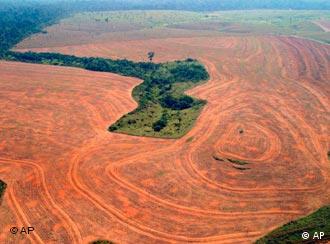
Aerial view of an area deforested in Brazil - deforestation is the second biggest contributer to climate change

New York Times -- A Brazilian government plan set to go into effect this year will bring large-scale logging deep into the heart of the Amazon rain forest for the first time, in a calculated gamble that new monitoring efforts can offset any danger of increased devastation.

The government of President Luiz Inácio Lula da Silva, in an attempt to create Brazil’s first coherent, effective forest policy, is to begin auctioning off timber rights to large tracts of the rain forest. The winning bidders will not have title to the land or the right to exploit resources other than timber, and the government says they will be closely monitored and will pay a royalty on their activities.

The architects of the plan say it will also help reduce tensions over land ownership in the Amazon, the world’s largest tropical forest, which loses an area the size of New Jersey every year to clear-cutting and timbering.

In theory, 70 percent of the jungle is public land, but miners, ranchers and especially loggers have felt free to establish themselves in unpoliced areas, strip the land of valuable resources and then move on, mostly in the so-called arc of destruction on the eastern and southern fringes of the jungle.

But the called-for monitoring of the loggers allowed into the rain forest’s largely untouched center will come from a new, untested Forest Service with only 150 employees and from state and municipal governments. That concerns environmental and civic groups because local officials are more vulnerable to the pressures of powerful economic interests and to corruption.

Further, the new system assumes that the world community will also play a part and buy timber only from merchants who are properly licensed and will avoid unscrupulous dealers.

The plan “can be a good idea in places where the situation is already chaotic,” said Philip Fearnside, a researcher at the National Institute for Amazon Research in Manaus who recently visited this remote area. “But it’s a different story in areas where hardly any logging or deforestation has taken place, where you are actually going to be encouraging the introduction of predatory forces that don’t exist there now.”

On paper and in principle, said Stephan Schwartzman, an Amazon specialist at Environmental Defense in Washington, “I think everyone agrees that this system is an improvement over the current situation, which is totally out of control.”

But in the end, he added, “everything is going to depend on how it is done and whether the financial and human resources are there to make it work.”

Here in this small settlement called Reality, along the rutted Highway BR-319, those resources do not yet exist, as residents have discovered. When outsiders recently appeared to fish out of season, wiping out protected species and killing three manatees, the peasants here went to the authorities looking for help, only to be turned away.

“They told us that we had to be the monitors ourselves, but we don’t have the ability to do that,” said Antonio Marfoni, a settler. “There’s no working phone here, and we don’t have the money or the time to be able to take the bus into town to denounce violations.”

Last October, during the final debate of the presidential campaign, the opposition candidate, Geraldo Alckmin, called the plan “irresponsible,” accused Mr. da Silva of wanting to “privatize the Amazon” and added, “If today there is no supervision, imagine what will happen if you hand it over to the private sector.”

Though the environmental movement was one of the founding constituencies of Mr. da Silva’s Workers’ Party, he made it clear after being re-elected to another four year term that his main goal was to get the Brazilian economy growing at 5 percent a year.

In November, he complained of “all the obstacles I have with the environment” and with “the Indian question,” which he said were hindering Brazil’s development.

But the proposal’s supporters dismiss criticisms as unfounded. Jorge Viana, who is a member of Mr. da Silva’s party and was governor of the Amazon state of Acre until Jan. 1, contends that “this is one of the most important initiatives that Brazil has ever adopted in the Amazon precisely because you are bringing the forest under state control, not privatizing it.”

“This is a battle Brazil has to win,” he added. “There’s only one way to save the forest, and that is by using it, responsibly and rationally.”

Claudio Langone, executive secretary of the Environment Ministry, said in a telephone interview from Brasília: “Brazil today is losing money due to the illegal exploitation of timber. With this new dynamic of management, legal deforestation and sustainable development, we want to create barriers to predatory advancement and increase the value of the forest.”

But some here fear that increased value will bring with it the kind of violence that has struck other more-developed areas of the Amazon.

Ivonete Aparecida Paes, a Roman Catholic nun who is the coordinator of the church’s Justice and Peace Commission in this area, said, “Since none of the settlers already here have titles to their tracts, that creates the possibility of greater conflicts over land ownership.”

After much debate, it was decided that the leases would run for 30 years. But Paulo Adario, director of Greenpeace’s Amazon campaign, said that “some species need 45 years or more to regenerate,” and that loggers might thus lack an economic incentive to care properly for a tract that would no longer be theirs when the trees they replaced reached harvestable size.

Already, there are signs of logging interests establishing themselves here. A sawmill opened just down the highway in mid-2005 and was operating at full capacity during a recent visit. Along the highway itself, there is now a clearing in which logs are piled haphazardly, like giant sticks.

“No one has the authorization to cut so much wood, even with a forest management plan,” said Leila Mattos, the director of Pacto Amazônico, an environmental group based in Humaitá, the closest town of any size. “I came by here at the beginning of November, and none of this was here. This is more than a year’s worth of timber.”

In addition, peasant settlers unable to obtain land of their own in Rondonia, a state south of here, have also begun moving up the highway and flocking to the area. Theirs is a pre-emptive action, aimed at establishing themselves on land that may go to logging companies later and thus forcing the government to give them other homesteads in return.

During an interview in Humaitá, Francisco Araujo, the director of the regional office of the governmental environmental agency, said that no matter who ended up in charge of supervising the timber extraction plan, the task would be hard. He complained of a shortage of gasoline and personnel and a lack of police protection for his agents.

“In reality, these conservation areas were created without very precise field studies,” Mr. Araujo said. “Only now are the technicians looking at the problems in the area. The infrastructure is very precarious. There is no equipment or physical base from which to operate, just a shack in which to stay, without a telephone.”

In the absence of the needed resources, he said, government policy envisions “a new partnership with society.” But those who work most closely with the peasant settlers who are being asked to bear that burden remain skeptical.

“To think that they can monitor violations in the absence of the state is a dream,” Sister Paes said. “The Amazon has no tradition of the poor standing up to the powerful. People simply don’t know how to do that.”

Wednesday, January 10, 2007

British Lawyers to Sue Trafigura Over Waste

Reuters/Planet Ark -- British lawyers suing Dutch-based oil trader Trafigura over toxic waste dumped in Ivory Coast are gathering evidence from thousands of victims for what they say will be one of Britain's largest class action cases.

The lawyers from Leigh Day & Co, based in London, are seeking financial compensation for people made ill by the toxic oil slops unloaded from a tanker chartered by Trafigura and dumped around the main city Abidjan in August.

"Our case is straightforward. We say Trafigura was responsible for bringing toxic waste down here to Ivory Coast," lawyer Martyn Day told Reuters in an interview on Tuesday.

"It was dumped in open dump sites instead of being treated and that toxic waste caused people's injuries."

The poisonous slops were unloaded from the Panamanian-registered Probo Koala tanker before being dumped at 17 mostly open-air sites. Ten people died and thousands were ill with vomiting, diarrhoea, nosebleeds and breathing difficulties.

Trafigura denies any wrongdoing and says it entrusted the waste to an Ivorian disposal company, Tommy, set up weeks before the ship's arrival.

Day said his law firm took on the no-win, no-fee case after being contacted by environment group Greenpeace.

It is seeking cash compensation for the victims through the British courts because Trafigura's London branch had chartered the vessel and bore most responsibility.

"There are probably four or five thousand people who have been seriously affected by the toxic waste dumping so we're going to be coming over here regularly to make sure anyone who wants to join the action can do so," Day said.

A hearing in London on Jan. 29 will determine whether the courts will accept the class action, a means of dealing simultaneously with large numbers of civil suits involving the same defendant and complaint, he said.

Day said the numbers of people involved would make the suit one of the biggest of its kind to be heard in a British court.

Day hopes Trafigura will agree to an out-of-court settlement. He said such a case could involve compensation payments ranging from 1,000 pounds (US$1,950) for mild injuries to 5,000-6,000 pounds for those more seriously hurt.

"People have to have lived close to the (sites) for us to be prepared to take the case on ... We have to prove each individual was injured," Day said.

Ivorian and Dutch authorities have started criminal investigations into the dumping.

A report commissioned by the Ivorian prime minister said in November that port, customs and district officials had been negligent and Trafigura had violated the Basel Convention by shipping toxic substances to a developing country.

Two French Trafigura directors have been detained in Abidjan and face charges under Ivorian poisoning and toxic waste laws.

Monday, January 08, 2007


Jamaica, Montego Bay, Cockpit country, landscape

AP -- Descendants of freed African slaves vowed Sunday to fight any plans for bauxite mining in the forested region of Jamaica where they have lived in semiautonomy for centuries.

The Accompong Maroons, descendants of slaves freed by the Spanish in the 17th century to repel invading British forces, will not allow mining companies into any part of their jungle territory, said Sydney Peddie, the group's leader.

"We will be joining forces with all the influential people to thwart this issue. It will not happen or else there will be war," Peddie told a news conference.

Last month, Jamaica's government withdrew a license for U.S.-based aluminum producer Alcoa Inc. and state-owned Clarendon Alumina Production Ltd. to begin bauxite mining in the northwestern region, known as Cockpit Country, following threats of street protests by environmental activists.

Agriculture Minister Roger Clarke said he would review scientific data presented by both sides and decide this month whether to grant the license. Jamaica is the world's fifth-largest producer of bauxite, the raw material for aluminum.

Peddie said opening up the territory to mining would breach a treaty signed between the Maroons and the British in 1739, which gave the group nearly 25,000 acres in Cockpit Country, an inhospitable terrain of rocky cliffs and limestone towers.

After getting their freedom, the first Maroons fled to Cockpit Country and repelled the British for decades before signing the peace treaty.

15 Dead Taken from Collapsed Congo Mine

Photo
Photo Courtesy: (AFP/File/Jerome Cartillier)

AP -- Fifteen bodies have been pulled from a diamond mine that collapsed in central Congo last week and further rescue efforts have been abandoned, officials said Sunday.

Three people were rescued soon after the mine in the town of Tshikapa caved in Friday, said Mayor Mwamba Mutombo. He said they did not know if others were in the mine when it fell in but said hope of rescue had been abandoned after two days.

Mutombo said the group appeared to have been teenagers who hoped that recent rains had uncovered diamonds in the community mine.

Mutombo said work at the mine has been suspended and two people in charge of the site have been arrested.

Such collapses are common during the wet season in Congo's diamond-producing region. Diamond concessions and community mines continue to operate in the midst of crumbling infrastructure ruined by decades of war and dictatorship.

The Central African nation produces about 8 percent of the world's diamonds.


Related Post
"Lesotho Promise" Sells for $12.36 Million

Model displays rare 603 carat white diamond in Antwerp

Ethiopian Forces Attacked in Somalia

Photo
A Transitional Federal Government soldier carrying a rocket-propelled grenade patrols a street in Mogadishu, Sunday, Jan. 7, 2007. Hundreds of Somali soldiers patrolled Mogadishu and clan elders held emergency meetings Sunday, a day after violence broke out during angry demonstrations against Ethiopian forces supporting Somalia's interim government. During Saturday's protest at least two people were killed, including a 13-year-old boy, hospital officials said. The violence on Saturday exposed deep unrest in a city that is seeing its first legitimate governing force in more than a decade. (AP Photo/Mohamed Sheikh Nor)

AP - Gunmen attacked Ethiopian troops supporting the Somali government Sunday, witnesses said, in the second straight day of violence in a city struggling to emerge from more than a decade of chaos.

Farah Abdi Hussein, who witnessed the attack, said gunmen launched grenades at Ethiopians about 2 1/2 miles from the airport. One Somali soldier was wounded, according to a Somali military official asked not to be named for fear of reprisals.

The unrest comes at a precarious time for Somalia's transitional administration, which is trying to assert some control for the first time in a capital that has seen little more than chaos in the 15 years since clan warlords toppled a dictatorship and then turned on each other.

The government, backed by Ethiopia's military, drove out a radical Islamic militia last week. But many in predominantly Muslim Somalia resent the presence of troops from neighboring Ethiopia, which has a large Christian population and has fought two wars with Somalia.

On Saturday, hundreds of furious protesters took to the streets, burning tires and smashing car windows while denouncing the presence of Ethiopian forces and shouting defiance at the Somali government's call for disarming Mogadishu.

Two people died in Saturday's violence, including a 13-year-old boy.

On Sunday, a similar protest took place about 215 miles away in Belet Weyne, after Ethiopian troops there detained a Somali military commander who refused to hand over an Islamic militiaman, witnesses said. That protest also turned violent, killing a 20-year-old civilian, Abdi Nor Salah Gedi told The Associated Press by telephone.

It was not clear who shot the man or the teenager killed Saturday.

Clan elders held emergency meetings Sunday and hundreds of Somali troops patrolled Mogadishu, setting up six extra checkpoints in areas where residents burned tires and broke car windows during Saturday's protests.

Dahir Abdi Kulima, a chieftain of the Hawiye, the dominant clan of southern Somalia, said the government's reliance on Ethiopia is backfiring.

"Since the Ethiopians arrived people are sleeping and waking with worry about what will happen next," Kulima told AP during a break in a meeting with about a dozen other Hawiye elders. "This is a sign of upcoming problems in Somalia."

Ethiopian soldiers, tanks and warplanes intervened in Somalia on Dec. 24 to defeat the Islamic movement, which had threatened to overthrow the internationally recognized government. At the time, the government controlled only the western town of Baidoa.

The most senior U.S. diplomat for Africa said Sunday that the United States would use its diplomatic and financial resources to support the Somali government.

"I think we are pushing uphill as an international community, as well as the Somali people themselves, to try to overcome their history," Jendayi Frazer, the U.S. assistant secretary of state for Africa, told AP in Nairobi, Kenya.

Frazer was planning a surprise visit to Mogadishu on Sunday but called it off because the details of the trip were made public, prompting concerns for her safety.

The African Union has begun planning for peacekeepers and Uganda has promised at least 1,000 troops. Frazer has said she hopes the first troops would arrive in Mogadishu before the end of the month.

Previous peacekeeping forces, including U.S. troops, met with hostility and violence when they tried to help in the early 1990s, and leaders of the routed Islamic militia are vowing from their hideouts to launch an Iraq-style guerrilla war.

After meeting with Frazer in Nairobi, a top Somali politician with ties to leaders of the militant Muslim movement urged its fighters to surrender and join the peace process.

Sheik Sharif Hassan Aden, speaker of the transitional parliament but a strong critic of the interim government, also dropped his opposition to having foreign peacekeepers in Somalia, calling on people "to welcome, to hail, to respect, to accommodate them in a peaceful manner."

Aden is closely linked to leaders of the militant Council of Islamic Courts, whose fighters scattered into the countryside after being defeated on the battlefield last week.

Frazer reiterated Somalia's importance to the United States because of its location in the Horn of Africa, where the Red Sea opens into the Indian Ocean.

The U.S. wants to make sure Islamic extremists do not take advantage of the chaos to establish a safe haven. Frazer has said al-Qaida's East Africa cell, blamed for the bombings of two U.S. embassies and a Kenyan resort hotel, infiltrated the Islamist movement in Somalia.

But Frazer stressed that the U.S. will provide only a support role.

"Some people would like the United States to lead on this issue," she said. "I would prefer that we lead from behind, and what I mean by that is pushing the Somali people first, pushing the sub-region next and then mobilizing the resources of the international community."